Order a Reading from Me

Order a Reading from Me
Please send relevant information to zannastarr@gmail.com.

Sunday, February 16, 2014

Three's Company: Sun, Moon, Ascendant

I just finished reading a Final Exam paper by one of my students in Astrology 101 (a course I teach at the Magical Circle School). The exam asks students to discuss how the “Big Three” – their Sun, Moon, and Rising signs -- interact with each other, how they support or conflict with each other, and how those interactions are expressed in their personality.

The student did a beautiful job with her Libra Sun, Libra Moon, and Aries ascendant. I thought it would be fun to offer my thoughts on my own Sun, Moon, and Rising signs from a Tarot perspective.

I am using the Celestial Tarot by Kay Steventon and Brian Clark (U.S. Games Systems, Inc.)

Celestial Tarot (U.S. Games)
My Sun sign is Sagittarius: Temperance (The Spirit of Sagittarius)

In the Little White Book (LWB) for this deck, Temperance is subtitled “The Spirit of Sagittarius”. The card depicts Artemis, the Greek goddess of the wilderness, the hunt and wild animals, and fertility. On the surface it may be difficult to relate this image of Temperance to the traditional “woman pouring liquid from one cup into another” (shown faintly in the upper right background on this card). However, the LWB makes the following observation: “Underlying this archetype is the struggle between the instinctual and the pursuit of higher knowledge and ethics. Similarly the card Temperance implies moderation and balance, finding the middle path, and discerning between right and wrong.” Temperance, reflection, and balance are needed if we are to move forward on the path to spiritual awakening and learning.

Sagittarius is one of several signs termed “dual signs” or “double-bodied” signs in astrology. The reason is that the traditional representative of Sagittarius is a centaur – half human, half animal. This further supports the idea of “the struggle between the instinctual and the pursuit of higher knowledge and ethics” mentioned in the deck’s LWB. The Romans associated the constellation Sagittarius with Chiron, a wise and gentle Centaur. Like Chiron, the spirit of Sagittarius not only seeks wisdom but also becomes a teacher, mentor, healer, and guide.

In the larger book accompanying this deck, Brian Clark writes that the spirit of Sagittarius is “to reason and judge clearly, not from a self-interested perspective, but from a holistic point of view.” He adds that Sagittarius encourages us “to differentiate the barbaric from the refined, the wild from the moderate, and to choose the path aligned with our highest ideals.”

The placement of the Sun in a birth chart represents the core Self or true Self, our identity and ego. I like this depiction of Sagittarius for the most part, although I am repulsed by the idea of hunting and killing animals, so the Artemis-as-hunter connection doesn’t resonate with me. However, the desire to find a balance in all things is very strong. My level of success has fluctuated, but the main thing I notice is that I am aggravated by people who take an extreme view of anything, a black-and-white or all-or-nothing approach. I seek the center, and I want and expect people to be reasonable. Needless to say, I am often disappointed.


Celestial Tarot (U.S. Games)
My Moon sign is Taurus: The Hierophant (The Power of Taurus)

On this card we see the god Zeus in the guise of a white bull. Sitting on the bull is Europa, a Phoenician princess abducted to Crete by Zeus. Behind Europa and the bull we see the Hierophant, “the priest who initiated thousands of pilgrims into the Eleusinian Mysteries” (LWB). Here we have the force and power of our passions (the bull), innocence and childhood beliefs (Europa), and the Hierophant who “initiates her into the quest for self-knowledge, the aspect of the self that beckons us to journey beyond our comfort zone.” (Clark) As presented in this deck, the Hierophant encourages us to direct and control our inner strengths and resources, our power and our passion, and to remain grounded in the world even as we seek to expand our self-knowledge and understanding. Indeed Taurus energy is viewed as down-to-earth, practical,

It is perhaps revealing that The Hierophant is one of my least favorite cards in the Tarot. I typically view the card as representing the rules and restrictions of organized religion and/or society’s established or approved way of doing things – and I have “issues” with all of that. Ironically, the reason for my resistance (or part of the reason) may lie in the fact that this energy has a strong presence in my birth chart. So I am resisting something within myself that I can’t or don’t want to come to terms with. In astrology, the placement of the Moon represents our interior life, our emotional instincts and habits. It is therefore possible that the Hierophant aspect of my nature is beneath the surface, deep in my subconscious, influencing my behavior and decisions more than I would like it to at a conscious level.


Celestial Tarot (U.S. Games
My Rising sign is Virgo: The Hermit (Virgo, the Wise Virgin)

Brian Clark tells us that many prominent goddesses and heroines have been identified with the constellation Virgo, which happens to be the largest zodiacal constellation. For this card the creators of this deck chose Hestia, Greek goddess of the hearth and home. Clark points out that although never associated with Virgo in ancient sources, Hestia embodies many of its attributes: “stillness, discretion, containment, veiled, virginal, centered and sacred.” She is viewed as the guardian of the astrological sixth house, the house ruled by the sign Virgo on the zodiac wheel.

On the card we see Hestia in the foreground, with the traditional tarot image of the Hermit holding the lamp in the background. In one hand Hestia carries sheaves of wheat, a symbol of cultivation. With the other hand she disseminates seeds for the new cycle. This is intended to reinforce our connection with “the cyclical nature of the goddess” and the idea that Virgo’s “wisdom of cycles needs to become consciousness.” (Clark) In the season of harvest, we are called to “withdraw into the internal realm to prepare and reflect.”

In astrology, the ascendant sign or “rising sign” represents the part of us that others see – the first impression we make, the “face” or “mask” we reveal. Some astrologers call it “the front door of the Self.” The face I present to others, at least initially, could well be described as silent or still, reserved and introspective – traits associated with The Hermit and Virgo.

I have always felt a push-pull kind of thing going on between my Sun (an active Fire sign) and my Moon and Rising signs (passive Earth). However, I sense a much more unified, compatible energy when I look at Temperance, The Hierophant, and The Hermit together. I really like that image!


So there we have it. If you have managed to stay with me through this self-centered analysis, perhaps you have seen or learned something useful to your own life journey. Or perhaps you are now inspired to explore your “Big Three” astrological signs as they relate to the Tarot.

Monday, February 10, 2014

Journey Through My Decks: 6 of Pentacles

With the Winter Olympics being hosted in Russia, I decided to take Journey Through My Decks to Russia by way of the Fantastical Creatures Tarot by Lisa Hunt and D.J. Conway (U.S. Games Systems, Inc.)

Abundance

The домово́й -- domovoy (or domovoi) -- was a house spirit in Slavic folklore. The word dom means "home" or "house" in Russian. These creatures were said to inhabit the hearth and home, usually living under the doorstep or stove, or in the basement.

A domovoy was inherently neither bad nor good. He took his cue from the residents of the house and their behavior. If they deserved his protection, he gave it willingly. Although rarely seen or heard, the domovoy made his presence known in various ways and was said to be moody and mischievous. He could take on the appearance of the homeowner or one of the homeowner's ancestors or a variety of other creatures. As one can imagine, the domovoy was treated with great respect by the residents of the home in which he lived. When families moved, they invited the domovoy to move with them.

On the Six of Pentacles in the Fantastical Creatures Tarot, we see a domovoy creating magickal pentagrams to protect his human family and bring them good things. The traditional association of the suit of Pentacles with domestic, everyday matters in the material world is maintained here.

Book T* calls the Six of Pentacles “The Lord of Material Success” and relates it astrologically to the Moon in Taurus.

DMs provided by Conway: "Abundance and prosperity will enable you to help someone else in need. You will be able to repay debts."

***

* Book T The Tarot (an initiatory manual for the Order of the Golden Dawn) Comprising Manuscripts N, O, P, Q, R, and an Unlettered Theoricus Adeptus Minor Instruction, A Description of the Cards of the Tarot with their Attributions; Including a Method of Divination by Their Use.

About the deck: In the Introduction to the LWB for this deck, we are told that the mythical beings depicted in the deck seem to "fit into a niche between humans and gods, a kind of middleman of the astral realms." These mythical creatures can be "good and helpful, neutral, or evil and harmful." Conway encourages us to "use the energy of Fantastical Creatures for magick, meditation, and divination. . . as a tool to improve yourself and your life."


Wednesday, February 5, 2014

Roles We Play

Throughout our lives we play many roles – within our family, in society, in relationships, at work, and so forth. Some of these roles we are well aware of (such as father, mother, daughter, brother) and others we are not conscious of or willing to acknowledge (such as nice person, victim, righteous one, angry person, drama queen, clown, ostrich). It can be interesting to explore the roles we play and how we feel about those roles.

With this in mind, I developed a couple of Tarot spreads to serve that purpose. They are simple spreads, and I imagine that somebody else, somewhere, has probably come up with similar ones. Nevertheless, these are my own creations, to the best of my knowledge.

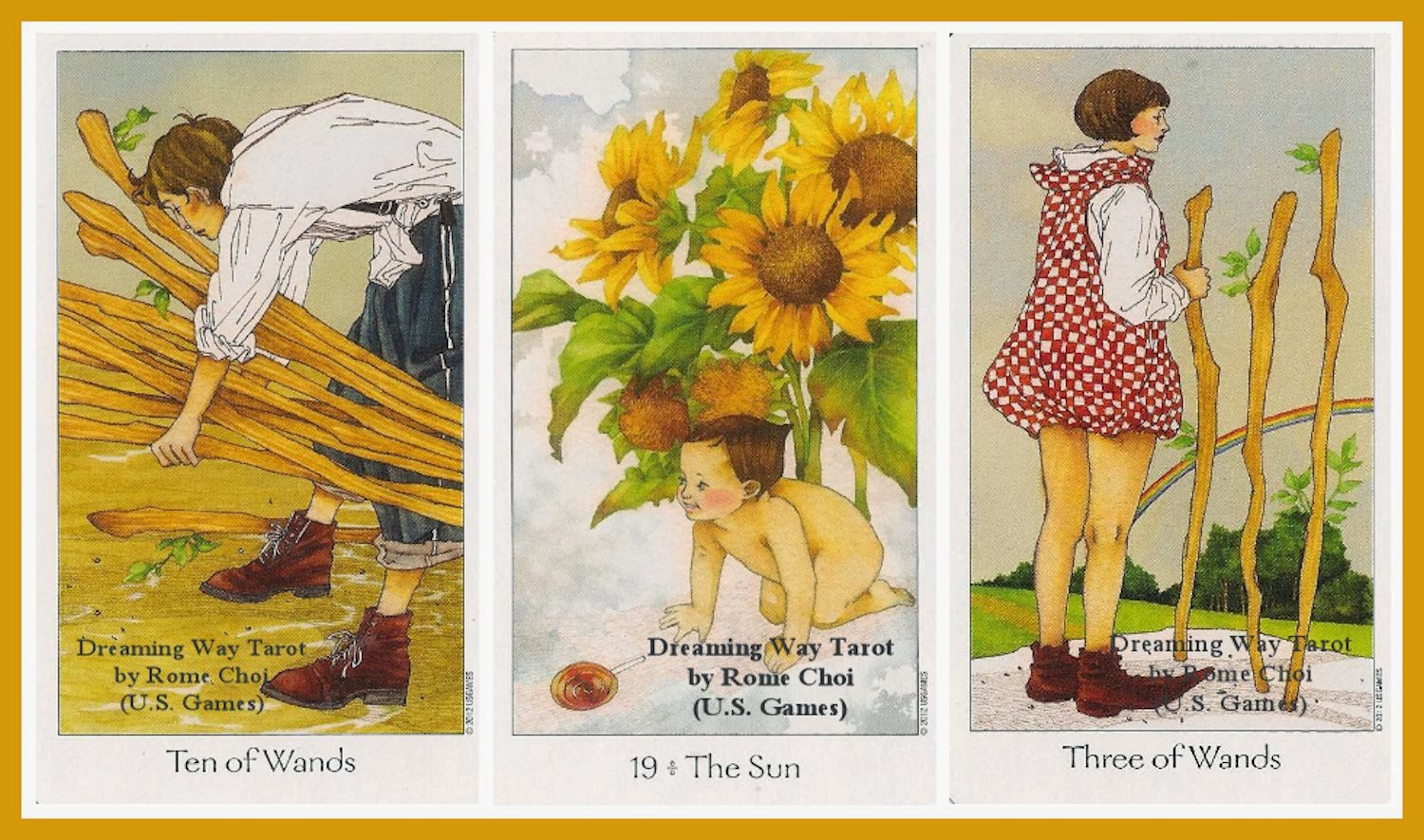
I am using the Dreaming Way Tarot by Rome Choi (U.S. Games Systems) to demonstrate these two spreads.

Reading #1

(1)..................................(2)......................................(3)

(1) a role I sometimes play (a mask I wear)
TEN OF WANDS: “the burdened one”
There are times when I feel overwhelmed by tasks, responsibilities, projects, etc. This happened more often when I worked outside my home. It seemed like one thing after another would happen until I felt I could just barely keep it all together, at which point something more would happen to “break the camel’s back.” These days, if I feel over-burdened, it is because I myself have taken on too much at one time either because I feel no one else will do it if I don’t or because it is somehow my responsibility or the “right thing to do.” Eventually, of course, this leads to resentment and irritation at other people, either because they are not helping or because they seem oblivious to the fact that I’m “doing it all” while they do nothing.

(2) how I feel about that role (mask)
THE SUN: successful
Okay, I admit it! I’m good at playing “the burdened one.” It gives me a certain satisfaction and actually bolsters my ego (“I can do it all. I will do it all.”) In astrology, the Sun represents our identity, and I am very good about identifying with this particular role, and I’m likely to feel that I am “the burdened one” rather than realizing that I am playing the role of “the burdened one.”

(3) best course of action
THREE OF WANDS: Look ahead. Involve other people.
The person on this card looks outward not inward, focusing on what lies ahead. The number Three commonly suggests the involvement of more than one person. Unlike the person on the 10 of Wands, who holds nine Wands and appears to be about to pick up a tenth, the person on the 3 of Wands holds onto only one Wand and does not pick it up or carry it. The other two Wands stand on their own. If I want to move away from playing “the burdened one,” I need to choose which Wand(s) to pick up and carry and which one(s) to set aside. On the other hand, if I truly enjoy playing “the burdened one,” I can just keep right on doing it, with the understanding that it is my choice.

Reading #2

(1)..........................................(2)

(1) a role I would rather not play
ACE OF WANDS: “the person in charge”
I really don’t like to be the person in charge of anything because that usually means that other people are involved, and I dislike dealing with group dynamics and personalities. I have no interest in motivating people or getting them to do things. I’m fine if it’s just me and maybe one other person. But the thought of leading a group activity or project gives me a headache. (And yes, this is based on experience.)

(2) what will help me avoid playing that role
KNIGHT OF CUPS: using good judgment and refraining from taking a leadership role simply because I can or feel I “should” (guilt trip)
In the past, I have had a tendency to respond to the need for “someone to take charge” like a knight on a white horse riding to the rescue. I see the need and I know I am capable and I really “ought” to do it… and before I can think it through, I raise my hand and say, “Oh, I’ll do it!” And I end up hating every minute of the job. I can avoid being put in that position by “reigning myself in” and waiting to see what more appropriate role I can play.

(3)..........................................(4)

(3) a role I would like to play
QUEEN OF CUPS: “the compassionate, intuitive caregiver”
I actually do play this role on occasion, but it doesn’t come naturally to me. I might feel compassion and my heart might go out to someone in a situation, but I tend to hold back those emotions and not reveal them. I may or may not express those feelings or act on them. In my heart and mind, I think I want to be this outwardly caring, nurturing, emotionally invested person – but when the opportunity arises to do that, I often withdraw instead. This suggests that perhaps this is a role that I cannot comfortably play, that it goes against who I really am, whether I like it or not.

(4) what will help me play that role
TWO OF CUPS: connecting and communicating with others at an emotional level
This really is the secret, isn’t it? If I cannot or will not connect and communicate with others at an emotional level, I am probably not going to feel comfortable playing the Queen of Cups role. It will feel artificial or forced. Forming emotional bonds with people is not one of my strengths. I shy away from that. Ultimately I may have to give up the idea of playing a Queen of Cups role, quit trying to force a square peg (myself) into a round hole (Queen of Cups role).

This has been an interesting and useful exercise for me. Feel free to give it a try yourself and let me know what you find out!

Sunday, February 2, 2014

Amethyst for February

I have not taken the time before now to explore a deck I acquired quite some time ago: The Tarot of Gemstones and Crystals, with instructions and interpretation by Helmut G. Hoffman (AGMüller Urania). I purchased this deck primarily to have a collection of images of gemstones and their meanings so that I could use that information in describing my handmade jewelry (_Jewelry by Scotti_).

However, this is a Tarot deck, and from time to time I will share it here on Tarot Notes.

Since this is the beginning of February, I am focusing on the birth stone associated with this month: amethyst. In The Tarot of Gemstones and Crystals, amethyst appears on the Death card (XIII).


Helmut G. Hofmann makes the following comments in the Little White Book that accompanies this deck: “This violet stone promotes humility and philanthropy. It brings light into problems and so helps us in the transformation from the mental to the spiritual level. It both soothes hardened souls and supports people with gentle natures.”

The link with transformation certainly applies to the Death card, which often speaks of beginnings, endings, letting go, and change.

February is the third month of winter in the Northern Hemisphere and the third month of summer in the Southern Hemisphere. On the Roman calendar, February 2 is halfway between the Winter Solstice and the Spring Equinox. In many traditions, February 2 is considered the beginning of spring. This concept also ties in nicely with the meaning of Death as transformation – the end of one situation and a new beginning.

Here is a pair of earrings I made using glass charm beads swirled with lavender and deep purple and Swarovsky light amethyst bicone crystals (with amethyst being a reference to the color rather than the gemstone):