Order a Reading from Me

Order a Reading from Me
Please send relevant information to zannastarr@gmail.com.
Showing posts with label Old English Tarot. Show all posts

Thursday, July 6, 2017

Old English Tarot: 9 of Cups

In today's blog entry, Helen Howell continues her exploration of cards from the Old English Tarot by Maggie Kneen (U.S. Games Systems, Inc.)

Old English Tarot
Nine of Cups
by Helen Howell

Old English Tarot

Today I’m looking at the Old English 9 of cups and comparing it to the more traditional Rider Waite card. At first look neither card bears a resemblance to the other. With the Rider Waite it is more obvious from the image that this is a card about satisfaction and emotional fulfilment. We see a man sitting in front of nine cups and looking very happy with himself. Very often this card has been called the “wish card” and it represents for us that what we desire emotionally can be achievable.

Rider-Waite-Smith Tarot
Now when I look at the Old English I don’t get that impression so much. What I like about the Old English Cards is that they make you think. What we have here is a boy doing a handstand and his drum is on the ground beside him. I suppose one could ask themselves why is he doing the handstand? Is the same as jumping for joy? Perhaps he has just mastered a difficult drum routine and this is his way of shouting “Yay!” I think from this image we can at least take the meaning of success and one that can make you feel good about yourself. By looking into the image and analysing it, we can determine that this is representative of emotional happiness and one of achievement. 

So although at first look it is not so obvious what it means as the Rider Waite image is, both cards do seem to be delivering the same message. Basically satisfaction, celebration and emotional happiness.

LWB:

Positive: Success, abundance, victory, Celebration

Reversed: Mistakes, material loss, imperfection

Tuesday, May 23, 2017

Old English Tarot: 4 of Batons

In today's blog entry, Helen Howell continues her exploration of cards from the Old English Tarot by Maggie Kneen (U.S. Games Systems, Inc.)

Old English Tarot
Four of Batons
by Helen Howell


Today’s comparison of the Old English and the more traditional Rider Waite is  between the 4 of Batons or Wands if you prefer. The images on both of these cards have a good feel about them. Certainly the idea of completion is portrayed in both of these.

Let’s look at the Rider Waite first, and I choose the Rider Waite first in all my posts, because it is the Mother of all the modern decks that followed, in that they are based on the Rider Waite tradition from what I can see. In the RW image we see four wands support a flowered garland, a crowd gathered to one side, a couple in the centre with their arms raised, holding bouquets of flowers and to the other side a bridge. This is definitely an image of celebration. It’s a card that tells us you have completed the first round. The bridge indicates that you still have further to go, but right now it’s time to relax.

I love the image in the Old English. We see lush trees, green green grass and what appears to be a peacock or maybe a very colourful turkey? If we look closely we also see four baby chicks in the grass. Mama has hatched her babies and that is one cycle complete. That’s a reason to celebrate and to enjoy the achievement after all that hard work sitting on those eggs! But they are just chicks and that reminds us that there is still a new cycle to begin.  When we look more deeply into the image, we see it speaks to us of harmony, prosperity (those green trees are growing well), and the results of hard work (hatching out the eggs). It says take the time to enjoy where you are, but it also reminds you that you cannot stand still forever. Chicks have to grow up!

Both cards deliver the same message, but with very different images. The meaning of the Old English is not always immediately obvious, but if you just take the time to study the artwork you’ll see the message is very clear.

LWB:
Positive: Romance, harmony, peace, prosperity, fruit of labor.
Reversed: Tarnished beauty, loss of tranquility.


Sunday, April 16, 2017

Easter Egg Spread from Helen

Please celebrate Easter with my fellow creator of Tarot Notes, Helen Howell, here to demonstrate her Easter Egg Spread!

Easter Egg Spread
created by Helen Howell on 27th March 2013

Easter seemed the perfect time to try out this spread again and demonstrate the Old English Tarot in action. I first showed this spread back in 2013 and I hope you enjoy using it once more.

image copyright Helen Howell

The layout is a simple horizontal three cards in a line.

1: Undo the Bow:  This is the potential that exists for me.
2: Peel off the wrapping: The new beginning that I hope for.
3: Break into the chocolate: The first step I must take to manifest this goal.

The Old English Tarot by Maggie Keen
Published by U.S. Games Systems, Inc.

1: Undo the Bow: Three of Cups
This card indicates a healing for me, where mind body and spirit can come together in harmony. The potential here for me is to bring about a satisfactory conclusion. (I know what this card is talking about and some of it’s health issues and some is relationship issue.)

2: Peel off the wrapping: The Moon
What I like about this image is that Moon shown is not a full moon but a New Moon. A New Moon can represent promise and of course the Moon in general does also represent creativity. So I guess the first step I should take is to clear all negativity from my mind and use my creativity to formulate a better approach to my particular problems.

3: Break into the Chocolate: Three of Swords
In this image I see three swords hanging over a castle, the castle being the goal, the place of security and abundance. The first step I need to take to bring about my goal is to set aside disappointments of the past. Clear away any conflicting thoughts I have about these two particular situations and gain a better sense of perspective which will show me the path towards that castle.

In conclusion then these three cards from my Easter Egg reading tell me that I can heal and bring harmony to body, mind and spirit if I clear all negative thoughts from my mind, and instead use a creative approach to solve problems. The very first step I need to take is to eliminate conflicting thoughts and to set aside disappointments from the past.  The past is the past and that’s where it should stay. Today is always another opportunity to do better. ^_^

~ Helen Howell

Monday, November 14, 2016

Old English Tarot: 8 of Coins

In today's blog entry, Helen Howell continues her exploration of cards from the Old English Tarot by Maggie Kneen (U.S. Games Systems, Inc.)

Old English Tarot
Eight of Coins
by Helen Howell

Today’s Old English Card is the 8 of Coins and I’ll be comparing this to its more traditional brother, as usual, the Rider Waite deck.

The Rider Waite 8 of Pentacles, as you probably know, depicts a young man working studiously on each pentacle. Here he strives to improve with each one he makes. The card’s fundamental meaning is commitment to a new form of skill. It’s a card that can translate into indicating that hard work will get you where you want to be and an ability to stay with the project in hand. As this is a Pentacles/Coins card, we are looking at the material world and so the other message from this card is: Take a practical approach.

Now it is easy to see and translate the meaning of the Rider Waite image but not so easy with the Old English 8 of Coins. Let’s take a look at the symbolism contained in the Old English depiction of this card.

We have have eight coins arranged in two lines of three with two in the middle - a perfectly balanced arrangement. Beneath this is what looks like a wine barrel, grapes to the back and grapes to the forefront of the card, two jugs of varying sizes, and two bowls. How do we translate this to mean similar to the Rider Waite?

At first look it’s not so obvious, but then we start to ask ourselves some questions: Why are there two jugs with different patterns carved into them and of varying sizes? Why two bowls that differ? What do the grapes stand for? Wine? Maybe, but I think they may mean something a little more deeper.

I’m going to list what I think these symbols might mean for us.

Grapes: Abundance, reaping the fruits of one’s labour. Achievement through care and attention to the plants. Hard work to gain a good crop.

Bowls & Jugs: If we look at the progress of the carving from the bowls to the large jug with the more elaborate design, then we see a progression of skill has taken place.

So it does appear that the Old English 8 of Coins does have a similar meaning to the Rider Waite 8 of Pentacles - perfecting skills, practice makes perfect, achievement through hard work.

It is the symbols that speak to us within the image of a card, and each modern deck will have its own variation of the core meanings of the Rider Waite. When you see the Old English 8 of Coins in a reading, somewhere in its meaning it’s going to suggest commitment  to gaining an end result.

LWB: Apprenticeship, craftsmanship, learning, effort, handiwork.

Reversed: Lack of ambition, vanity, disillusionment.

Thursday, July 7, 2016

Old English Tarot: 5 of Batons

In today's blog entry, Helen Howell continues her exploration of cards from the Old English Tarot by Maggie Kneen (U.S. Games Systems, Inc.)

Old English Tarot
Five of Batons
by Helen Howell
Today I’m looking at the Old English 5 of Batons and comparing it to the more traditional Rider Waite card. The visual we have here is very different to the one more often depicted for the 5 Wands (Batons). When we look at the more traditional Rider Waite, we can see from the image of the five figures that they are in some sort of struggle. Now this could of course be just competitiveness but also it may well show us some sort of conflict going on.

In the Old English we get a completely different image, but it is one that delivers the same sentiment as its more traditional brother and that is competitiveness, struggles and a situation that can be trying and irritating.  What we see growing out of the brown soil is a crop that the farmer has planted and it is being besieged by a murder of crows in competition with each other for the prize of the food. Now no doubt this activity will be very irritating to the farmer and his efforts to protect his crop somewhat trying.

So there we have it, two cards with very different images both delivering the same sort of message, that is one of trying times, or competitive times. It can be telling us of the obstacles that one encounters in everyday life that can be frustrating to deal with but not necessarily that hard to overcome. After all, all the figures in the Rider Waite card need to do is learn to work together and as for the crows, well the farmer needs a really scary scarecrow!

LWB says: Struggle, labor, setbacks, unsatisfied desire.
Reversed: Trickery, contradiction, complexity.

Saturday, May 21, 2016

Old English Tarot: 9 of Coins

In today's blog entry, Helen Howell continues her exploration of cards from the Old English Tarot by Maggie Kneen (U.S. Games Systems, Inc.)

Old English Tarot
Nine of Coins
by Helen Howell


I really like the depiction on the Old English 9 of Coins and like its more traditional brother the Rider Waite, it shows us an image of comfort and accomplishment. We all know the Rider Waite image of the lady in the garden, surrounded by the nine coins and we know that this is an image of wealth.

The Old English image shows us a couple seated together and toasting each other with a drink.  A garland decorates the wall behind them and the flooring is a rich checker-board pattern. I like that unlike the Rider Waite card, we have a couple here, a symbol of sharing their wealth and good fortune, as opposed to the lady in her garden who is enjoying it all by herself.

The Old English suggests comfort and prosperity but what I like most about this imagery is that it may symbolise for us the essence of sharing, in other words it’s not just about accumulating wealth, it’s about what you do with it that counts. The couple seem to indicate to me that abundance is not just about money. In this image we see comfort, but we also see emotional prosperity along with physical wellbeing. What they have accomplished they now share together.

LWB: Accomplishment, foresight, prudence, material well-being, love of nature.

Reversed: Stagnation, carelessness, lack of determination or direction.

Thursday, April 28, 2016

Old English Tarot: 4 of Cups

In today's blog entry, Helen Howell continues her exploration of cards from the Old English Tarot by Maggie Kneen (U.S. Games Systems, Inc.)

Old English Tarot
Four of Cups
by Helen Howell

Old English Tarot

I have to say that if I didn’t know the traditional meaning from the Rider Waite deck for the 4 of Cups I would be totally stumped with the image shown on the Old English Card. All we have are four cups and beneath them a figure playing two flutes.

Rider Tarot
The LWB tells us that the meanings attributed to this card are: Weariness, disappointment, a bitter experience (Reversed: Fresh possibilities, new relationships.) Well, I guess if we look at the figure having to play two flutes at one time, we could assume that he would become weary of this and maybe disappointed that the other flute player didn’t turn up!

Its more traditional brother, the Rider Waite, gives us more to get our teeth into and we see a figure sitting under a tree, arms crossed and eyes looking downwards. In front of him are three cups and a fourth is being offered as a gift, but alas he sees none of these things. Yes, our figure is bored with life and discontent with his lot so that he misses the opportunity of what is available to him.

Now, I supposed our flute player could also get bored having to play those two flutes all by himself; however, as I said, if I didn’t know the basic meaning of the Rider Waite card I would certainly have had trouble trying to decide what the Old English card was representing.

You’ll have to make your own minds up about this one.

Monday, March 14, 2016

Old English Tarot: 2 of Coins

In today's blog entry, Helen Howell continues her exploration of cards from the Old English Tarot by Maggie Kneen (U.S. Games Systems, Inc.)

Old English Tarot
Two of Coins
by Helen Howell


Rider-Waite Tarot
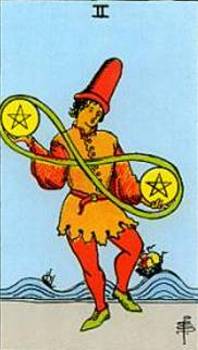
The Old English depiction of the 2 of Coins does not speak as clearly to me as its more traditional brother the Rider Waite.  In the Rider Waite we see a figure balancing two coins which appear to run around a never-ending loop shaped in a figure eight. Behind him we see choppy seas upon which a sail boat rides. We are left in no doubt with this image that the message it is delivering is one of movement, and shifting energy as seen in the choppy sea. This image speaks to us of the need to handle various factors in life, remember it’s Pentacles and that relates to the tangible, in order to make a success of them.

However, in the Old English we see a ship on a calm river, sailing away, at least it looks like that to me, from a village/town. The water has hardly a ripple in it and the boat is making very little headway. This can suggest a lack of movement, some difficulty in getting something off the ground. Even though this image is very different from the Rider Waite, it does reflect the idea of the need to handle various factors in life in order to get them running smoothly. For example, the people who set sail should have first checked the wind factor. After all it is a sail boat! Maybe they needed to make sure there were some oars aboard. But I do get the feeling with this card that it speaks more of difficulties rather than of movement.

LWB: Difficulties in launching new projects, difficult situations arise, worry.
Reversed: Able to handle matters, a letter

Wednesday, February 3, 2016

Old English Tarot: Ace of Cups

In today's blog entry, Helen Howell continues her exploration of cards from the Old English Tarot by Maggie Kneen (U.S. Games Systems, Inc.)

Old English Tarot
Ace of Cups
by Helen Howell


The Old English Ace of Cups is not unlike its traditional brother the Rider Waite as they both show us a cup that is overflowing. If we remember that the Aces of the suits are just the beginning, they signify the potential of what the suit is about. Cups of course are the element Water and expressed through emotions, feelings, imagination and inspiration.

In the old English we see a cup that is full with ripe grapes, some dangle over the edge. There are also green leaves nestled in between the grapes. Green is a colour that often signifies expansion, growth, potential balance and creativity. The grapes, being fruit also symbolise for us abundance, but the pips inside which are the seeds, go on to represent new beginnings, the potential of something to become more.

When we look at this depiction then and keep in mind what the suit represents, then it gives us a message of a fullness of emotions and feelings. It indicates to us that a joyful time could be ahead, or it could simply be saying that one needs to understand the way they are feeling about something because those feelings are filling us right now. Because of the potential aspect of this card along with the colour green, it can indicate that a creative time is about to emerge that is full of potential.

All in all the Ace is a nice card to have especially from its positive point of view, as it tells us that a good time is ahead.

LWB says: Abundance, perfection, joy, fullness beauty, favourable outlook.
Reversed: Change, instability, unrequited love

Thursday, January 7, 2016

Old English Tarot: 7 of Batons

In today's blog entry, Helen Howell continues her exploration of cards from the Old English Tarot by Maggie Kneen (U.S. Games Systems, Inc.)

Old English Tarot
Seven of Batons
by Helen Howell


I’m kicking off the new year with some more Old English Cards and as usual comparing their meanings agains the traditional Rider Waite Deck. 

Rider-Waite Tarot
First let’s take a look at the traditional Rider Waite 7 of Wands. As you know this suit’s element is Fire and is expressed through action and creativity. In the Rider Waite illustration we see a man standing atop a cliff. Six wands are below him and he has one wand held up in a defensive pose. You could almost say he is standing his ground. This is a card that speaks of courage and willpower and the ability to remain flexible in a challenging situation.

Now when we look at the Old English depiction, we get a very different picture. We have a figure walking along with the aid of a walking stick. The trees to the side of him are wind blown and his cloak is also wind blown. It looks like the wind is pushing him along.  Indeed it may well be a challenge for him to keep on course! However, the figure keeps going towards his goal and so this card also speaks to us, although in a less dramatic way than the Rider Waite, of courage, willpower and the ability to remain flexible in the face of an obstacle in order to overcome it.

I like the Old English visual as it’s less aggressive than its more traditional brother and to me it speaks of quiet courage. Of having the willpower to see something through to a successful finish -- and not only willpower but sheer determination to overcome any difficulties one may come up against. Why he may even be using that wind behind him to help him move forward! And there we have the element of flexibility to work around that obstacle so that it doesn’t hinder but can be put to good use.

Either way both these cards speak of the need to keep moving and keep learning new skills in order to stay on top. But both tell us that although one can be successful it will not come without some hard work. (Have you tried walking in a very strong wind? ^_^ )

LWB says:
Gain, overcoming challenges and obstacles, success.
Reversed: Anxiety embarrassment

Friday, October 2, 2015

Old English Tarot: 8 of Cups

In today's blog entry, Helen Howell continues her exploration of cards from the Old English Tarot by Maggie Kneen (U.S. Games Systems, Inc.)

Old English Tarot
Eight of Cups
by Helen Howell


I have the Old English 8 of cups card by the side of the Rider Waite and as I study the two I can see similarities and also differences. Because this is a Cups card we can take it that this is all about emotions, feelings, etc.

In the Rider Waite we see a man abandoning the eight cups. I like that there is a gap in the top row, to me indicating that something is left unfinished. He heads towards a mountain, perhaps seeking higher ground. This card speaks fairly loudly of letting go of that which isn’t working, emotionally breaking those ties and finding a better ground from which to stand.

When we look at the Old English we get an image of 8 cups and beneath them stands a figure playing his flute. Behind him is a drum that has quite obviously been abandoned. The question here though is, has the figure abandoned it for the flute? Or did someone else leave it and the figure to play alone?

The similarity I see between the two cards is one of abandonment for whatever reason, but the difference is that the man is not walking away. However, the fact that he chooses to stand and play the flute could indicate that he is not going to allow the relinquishment of the drum to hold him back but rather to play on.

Again I can draw a similarity to the RW card at this point of emotionally breaking the tie of something that is not working but seeking to get on with his life in his own way.

Both cards therefore, in my opinion, offer the interpretation of letting go and moving on.

LWB says:
Abandonment of previous plans, discontinuing a project, shyness, modesty, disappointment.
Reversed: Festivity, happiness.

Saturday, September 5, 2015

Old English Tarot: 9 of Batons

In today's blog entry, Helen Howell continues her exploration of cards from the Old English Tarot by Maggie Kneen (U.S. Games Systems, Inc.)

Old English Tarot
Nine of Batons
by Helen Howell


At first look the Old English 9 of Batons had me wondering how to interpret it. Its traditional brother the Rider Waite’s image is far easier to read, in that the figure of a man wounded and yet still standing guard tells us a story of inner strength and courage -- courage and determination to face one’s enemies, even if they are hidden.

So how do we interpret the image of the Old English?

What is depicted is a haystack of sorts. The bundles of dried wheat etc. are piled together, some on top of the others forming a tightly packed stack. Now, alone each sheaf would be weaker but together they have strength, both from the outside and inside. Perhaps this is the equivalent to the Rider Waite inner strength image. We can’t see inside the stack, so again we don’t know if something is hidden within, something that could harm us maybe? This depiction therefore does tell us similar things to the Rider Waite interpretation. But another way to look at this card is also that the sheafs are harvested and now await the next stage, so indicating a small break from the routine around them.

From what I can see the Old English card does speak of inner strength, and also of things hidden but adds that dimension of temporary relief, a chance for a break from the everyday routine or situation you might find yourself in.

What I find of assistance in interpreting these minor cards from the Old English is a good understanding of the basic meanings of the Rider Waite deck, which as we all know is the mother of the modern day clones.

LWB says:
Difficulties expected, anticipation, hidden enemies, a temporary break in the struggle.
Reversed: Delays, barriers to be overcome.

Wednesday, August 12, 2015

Old English Tarot: 7 of Coins

In today's blog entry, Helen Howell continues her exploration of cards from the Old English Tarot by Maggie Kneen (U.S. Games Systems, Inc.)

Old English Tarot
Seven of Coins
by Helen Howell


I’m back looking at the minor cards in the Old English Tarot Deck and today it’s the 7 of Coins. Now I always compare these cards to their traditional brother the Rider Waite Deck  and as I glance at these two cards side by side one significant difference hits me. In the Rider Waite we see an image of a man contemplating his harvest. It tends to speak to me of being at a crossroads and evaluating what you have achieved. The Old English image doesn’t appear to depict this element.

Let’s take a closer look at the image of the Old English and what the symbolism in it could mean. In the background we see a castle on a hill. This could suggest a goal or security.  The green hill could suggest for us how the earth nourishes, green being a colour associated with growth, expansion, balance, potential, fertility. The fields of wheat also indicate growth and abundance. The fruit tree laden with pears could represent good solid roots that have resulted in success. Two baskets are filled with produce, again showing abundance, a good harvest. The figure sits on the grass (green again) and appears to be counting out what looks like nuts. I have read that nuts or at least nut trees can be a symbol of perseverance.

Taking all of these images together it really does speak to me of having achieved a good result from putting in the effort and patience. Everything around the figure indicates success and progress. So unlike the Rider Waite image, which gives me a strong feeling of reevaluation, this Old English one, at least to me, speaks of success through hard work and the opportunity to reach one’s goal. However I am left wondering why the figure is counting those nuts? Perhaps after all there is an element of reevaluation tucked away in this card. You’ll have to make up your own mind about this one.

These interpretations are purely from my own perspective. You may see something totally different to me, and that’s ok too. If you do, don’t hesitate to share. We can all keep on learning.

LWB says:
Ingenuity, growth, progress, monetary gain, good result from work.
Reversed: Selfishness, avarice, bad debts.

Monday, June 15, 2015

Old English Tarot: 6 of Swords

In today's blog entry, Helen Howell continues her exploration of cards from the Old English Tarot by Maggie Kneen (U.S. Games Systems, Inc.)

Old English Tarot
6 Swords
by Helen Howell


I’ve always liked the 6 of Swords in most decks as it has represented the opportunity to change what has not been working. Of course if we remember it is a Swords card, then we know that the card relates to our thinking and our ability to communicate. But of course this card has a general meaning of travel associated to it as well.

As other cards have shown, the Old English image differs slightly in its message to that of its traditional brother the Rider Waite. Of course we all know the image of the Rider Waite card of the six swords in a boat with its passengers and the ferry man. What those six swords seem to me to represent is that unless you understand why the original thought patterns you have, have caused you problems, then moving won’t solve them, as you just take them along for the journey! However, the card image does show us in its depiction of rough water on one side and smooth on the other, a degree of moving away from a difficult situation and towards something less fraught. So that sense of a brighter future exists.

The Old English doesn’t show us that transition from rough to smooth in its image, but it does most definitely show us movement. We have a female on a horse galloping along and ahead of her running two dogs. They all seem to know where they are heading: The direction is forwards! This card’s image then seems to speak to me of travel and of moving towards something new. Although it’s a Swords card, the image of the swords crisscrossed does seem to me to form some sort of barrier, and perhaps again it’s an indication that we must first understand our thought pattern in order for it not to be something that holds us back. The trees in this image are all in full leaf and fruiting. That sort of gives me the impression that the potential exists for a goal to come to fruition, but also the trees seem to be blown about by the wind, maybe reinforcing the air element of the Swords suit.

In the final conclusion, to me both the Rider Waite and the Old English speak of moving oneself towards something better. However, they both caution that in order to move into that new space one needs to understand the thought pattern that created the undesirable situation that they are now attempting to move out of.

I really do like these little drawings on the bottom of each of these Old English cards. They bring an extra dimension to my understanding of the traditional meanings to the cards.

LWB says:
Journey, travel exploration, overcoming difficulties, success after anxiety.
Reversed: Stalemate, unsavoury proposals.

Tuesday, May 19, 2015

Old English Tarot: 10 of Cups

In today's blog entry, Helen Howell continues her exploration of cards from the Old English Tarot by Maggie Kneen (U.S. Games Systems, Inc.)

Old English Tarot
5 of Coins
by Helen Howell


The Old English 10 of Cups has a sort of tranquility to its image but the one thing it doesn’t show us like its traditional brother the Rider-Waite, is any connection to relationships.

In the Rider-Waite we see a man and a woman together and two children playing happily to the side of them. This image hints at happiness and harmony within relationships or family life. Emotionally, because that is what the Cups suit represents, this is a time for contentment. Everything in your world is working as it should be.

Now although the Old English does not show us that combination of harmony within relationships, it does show us harmony. A woman sits playing a harp. I can just hear those notes floating into the atmosphere, soothing to the ear. The player and her music are in harmony with each other. If you look closely at the image you will see a dove sits on the top of the harp. Doves very often are associated with spiritual matters or seen as messengers, but they can also represent peace and here in this image, it does seem to appear to me to symbolise for us inner peace.

Now when I look at this image and put those symbols together I get the feeling of contentment and the joy the music can bring. I’m left in no doubt that the message here is one of emotional peace, happiness and contentment with life as it is.

For me this was one of the easier images in the Old English Tarot to lend an interpretation to.

LWB says:
Happy home and family life, pleasure, contentment, love.
Reversed: Loss of friendship, unhappiness, quarrel.

Saturday, May 2, 2015

Old English Tarot: 5 of Coins

In today's blog entry, Helen Howell continues her exploration of cards from the Old English Tarot by Maggie Kneen (U.S. Games Systems, Inc.)

Old English Tarot
5 of Coins
by Helen Howell


The 5 of Coins is such a sad card to receive as it’s a card that very often speaks of difficulties in the material world. Some readers see Coins as meaning money and indeed they do, but they represent far more than money. They talk of the tangible things in life, and the 5 forebodes a sense of anxiety.

The Old English differs from its more traditional brother in one specific way, and that is a lack of sense of hope. In the Rider Waite card we see two people fallen on hard times, passing a church window. Within that image of the window is the symbol of hope, if only the two figures were brave enough to go inside and ask for help. The church window image can  also signify for us a purpose. It could represent something which may give our life meaning, something perhaps the two figures have lost.

The Old English, however, just shows us that sense of loss in its image of dead trees and browned grass. We look at this and can see that all has died. The grass has dried up and the earth has not sustained those trees which now stand leafless on the barren ground.

From this we cannot mistake the message of hardship and loss of something in our material world, whether that be financial or otherwise. The element of hope that exists in the Rider Waite is nowhere to be seen in this image. It clearly shows us that this is a time of uncertainty. 

Does the 5 of Coins just foretell hardship or is it a card that serves to warn one to check that all is well in their world? Perhaps it is and in heeding its warning one may be able to prevent or at least lessen the loss.

This is a number 5 card and I think the Old English demonstrates very well the numerological aspects associated with 5s in a tarot deck and that is, conflict, challenge but also opportunity to change. What 5s very often show us is that it is how we respond to life’s changes that determines the result.

The LWB says:
Material trouble, destitution, loss, error.
Reversed: Reversal of bad trend, new interests.

Sunday, March 29, 2015

Old English Tarot: 10 of Swords

In today's blog entry, Helen Howell continues her exploration of cards from the Old English Tarot by Maggie Kneen (U.S. Games Systems, Inc.)

Old English Tarot
10 of Swords
by Helen Howell


The Old English 10 of Swords just like the Rider Waite card, leaves us in no doubt that something is coming to an end. Both cards show us an image that we cannot mistake the meaning of. However, the images do tell a slightly differing story. Let’s take a look at the more traditional Rider Waite card first.

Rider-Waite Tarot (US Games)
In this image we see a man that lies face down with ten swords sticking into his back - you could say he is pinned down by some sort of personal pain. But it is worth noting that the fingers on his visible hand appear to be held in the sign of forgiveness/blessing (benediction). This indicates, at least to me, that in order to move on from this situation, and allow this ending to take place, one has to realise that it is over, finished with, etc. Because this is a number 10 card (1+0 = 1), it represents for us endings and beginnings all in one number.

The key element, I think, of the Rider Waite image is that whatever has caused one the pain, the only way to begin again is to forgive and move on. Because when we forgive what we do is actually free ourselves. So the image of the man shows us that he’s already been stabbed in the back. What else could happen? The worst is probably over, and now is the time to recover from it.

The Old English however, doesn’t appear to show us any recovery. What we get is a stormy sea and a sinking ship. I see no life boats, do you? How do you recover from that? What this card suggests to me is that some disaster has taken place. What was or is, has now come to an end. I get the sense that unlike the Rider Waite image, which tends to give me a sense of personal pain, the Old English image speaks more of some material loss – unless, of course, we put ourselves on the actual ship. But there is nothing to depict this. We are left in no doubt that this could foretell for us some sort of trouble or loss.

But wait! If we look closer at the image, we will see in the background there is land, and if we place ourselves in the ship then perhaps that is an indication that we can swim to safety. One just has to acknowledge they are on a sinking ship to get off in time to save themselves. So hidden in this image is the suggestion of recovery, and an ending and a beginning.

It appears then that the Old English has more in common with its traditional brother the Rider Waite than I first thought.

I think the fundamental message that both these cards bring home to us is that the worst is over and that we need to make an effort to bring it to its conclusion before a new beginning can be embarked on. How does one do that? By recognising that whatever it is, is over. The choice is always our own.

LWB: Ruin, desolation, trouble, sorrow.
Reversed: Benefit, temporary gain, passing success.

Sunday, March 22, 2015

Old English Tarot: Ace of Coins

In today's blog entry, Helen Howell continues her exploration of cards from the Old English Tarot by Maggie Kneen (U.S. Games Systems, Inc.)

Old English Tarot
Ace of Coins
by Helen Howell


What a nice visual the Old English Ace of Coins makes. Very different again from the Rider Waite traditional card, although the message conveyed in both cards is much the same.

The Rider Waite has a hand that offers a large pentacle, again the hand a symbol of a gift, the gift is the tangible. The Pentacle or Coin, whichever you choose to call it, can very simply mean that the time is right for going ahead with a money making idea, or that prosperity is in the cards! In the Rider Waite card, the garden is shown as lush and green, green being a colour that can represent adaptability, growth, balance, expansion and creativity.

The Old English shows us a house with a tree each side and that stands facing a field of wheat that is ready to harvest. When I look at this image I get the message that it says the time is right now to harvest that crop if you want to make the best of it. What I do see in this image more than I see in the Rider Waite one is that it shows us how the process through the other three suits has brought us to this moment. In other words, how the thoughts (swords) and the emotions that drive us (cups) have resulted in the necessary action (wands) to now manifest that initial idea into something tangible (coins.) If we look at this image we know that the farmer who lives in the house had the idea (swords) to buy wheat seed and a good feeling (cups) about how successful it could be, and so went ahead and planted and tended it (wands) in order to manifest it into a viable crop.

If we know our traditional meanings then we know the Rider Waite card speaks of this, but the Old English doesn’t just speak of this, it clearly shows us the results of those previous three suits and how this has manifested into the material form.

So the message may be the same for both cards: Manifest those ideas into something tangible. Whenever you see an Ace in a reading it always heralds new beginnings unless of course you’re reading its negative form. The one thing to remember, though, whatever the goal is, it is dependent upon your action to set it in motion.

A nice thing to also remember with all Aces is that its corresponding Major Card is the Magician and I like to think of that card as saying “The magic lies in your hands!”

LWB says:
Perfection, material and spiritual prosperity, bliss, attainment, treasure.
Reversed: Prosperity without happiness, wasted money.

Saturday, March 14, 2015

Old English Tarot: 5 of Swords

In today's blog entry, Helen Howell continues her exploration of cards from the Old English Tarot by Maggie Kneen (U.S. Games Systems, Inc.)

Old English Tarot
5 of Swords
by Helen Howell


The image on the Old English card is totally different to that which we see on the traditional Rider Waite. The Rider Waite shows us two men walking away defeated while another stands victor holding three of the five swords, while two lay at his feet. This card with its symbolism often makes me think that it’s urging one to work within their limitations, not to take on something they really cannot achieve. But the man who holds three of the swords and has two at his feet also seems to be saying you’ve won, but have you really? After all, the other two are walking away from him. Was it worth it to be alone?

Now the Old English image shows us an image of defeat but not one where the defeated are walking away. We see soldiers with their swords pointing at a group of peasants; one soldier even has his sword raised ready to strike them. This card speaks of aggression to me. Again one asks themselves: Did the peasants mean to confront the soldiers, or did they stumble upon them by accident? Who we identify with in this image alters the way we may choose to interpret the card.

 If we identify with the group of peasants, then the card speaks of defeat and talks about evaluating a situation and acknowledging the limitations of it before making a decision about whether to go ahead or not. Remember, this is the Swords suit and the energy comes from the Air element which is expressed through thoughts, mental activity and communication. It’s all about how we think and how we act on those thoughts.

If we identify with the soldiers, then the card speaks of winning, of an aggressive approach to achieve what you want. But remember: If the soldiers kill the peasants, the question that then begs answering is, at what cost was winning and was it worth it?

I think the one thing the Old English shows us, that is more subtle in the Rider Waite card, is that it could just simply represent facing one’s competitors. What both cards do ask of you, if it comes up in a reading, from what I can see, is that it is how you use your thoughts and what strategies you put in place that can, if not well thought out, isolate you from  others. In short, what both cards’ message is fundamentally about appears to be facing up to  your situation in a realistic way.

LWB says:
Conquest, defeat, degradation, facing adversaries.
Reversed: Uncertain outcome, weakness, possible misfortune.

Wednesday, March 4, 2015

Old English Tarot: Ace of Batons

In today's blog entry, Helen Howell continues her exploration of cards from the Old English Tarot by Maggie Kneen (U.S. Games Systems, Inc.)

Old English Tarot
Ace of Batons
by Helen Howell


I really like the Old English rendition of the Ace of Batons (Wands in the Rider Waite deck). It tends to show you all in one visual: the beginning, the breakthrough and the opportunity. Its more traditional brother, the Rider Waite, does show you the potential that exists in the form of the leaves sprouting and the goal in the form of the castle. The hand represents it as a gift, the gift of taking that creative force that exists and doing something with it. But I feel the Old English shows us that old adage – “Mighty oaks from little acorns grow” -- of course, meaning from little ideas bigger things can come.

Let’s look at the symbolism within this card.

 I love that it has a blue background, a colour that, for me, has come to represent reflection, intuition and the flow of ideas. As a sky it can also suggest the higher self. We have a tree, and in the bottom of the picture we can see its roots spreading out beneath the earth and the grass growing on top. The roots can represent for us those ideas that we have now set in motion. The brown earth can suggest a groundedness while the green grass represents the potential, balance and adaptation of those early ideas. The trunk shows us how those ideas or plans can grow into something strong, something stable and lasting. The green leaves and branches, to me, suggest the branching out of those ideas. On top we have a bird. The tree has provided the bird with the opportunity to rest. The bird is a creature of the sky and therefore can represent the higher self. While resting on the tree branch, it appears to me to be a symbol of allowing that higher self, that intuition one has, to connect to that initial idea and help it grow.

Aces as we know are the raw energy of their suit. They are embryos waiting to be born. We can look at them as the potential of what they could be and this Old English Ace, from my perspective, shows us quite clearly that if we allow our higher self/intuition to guide us and connect with our ideas, we can grow them into something worthwhile.

Now, this is just my view of this card. As always, you may see something totally different in its symbolism. However, remembering that Batons/Wands come from the Fire Element and are expressed through creative energy/action and intuition, this card -- just like the Rider Waite card when it appears in a reading -- can tell you that the time is just right to grab that idea and set it in motion. It says: Time to face the challenge for it could take you in a whole new direction.

LWB says:
Creation, new beginning, invention, fortune, birth, at the threshold of an exciting experience.
Reversed: False start, cloudy outlook, emptiness.