Order a Reading from Me

Order a Reading from Me
Please send relevant information to zannastarr@gmail.com.
Showing posts with label Tarot Books. Show all posts

Monday, July 12, 2021

REVIEW: Tarot by the Moon

R E V I E W

Tarot by the Moon
Spreads & Spells for Every Month of the Year
by Victoria Constantino
Llewellyn Publications
Paperback and Kindle

US Release: August 2021
UK/Canada: September 2021


_About My Reviews_

I hope this review is helpful! Below are links to sample readings I have posted using spreads from this book:

_Letting Go Spread (for July)_

Here are three of my favorite things about this book:

1. The Introduction. It covers so much great information, such as Tarot and the Moon, How to Make the Most of This Book, The Stance of This Book, Interpreting the Tarot, Numerological Correspondences, Tarot Symbols and Their Meaning, Preparation for Spells and Rituals, Days of the Week and Corresponding Energies, The Influences and Qualities of the Moon Phases, Unique Moons, and Color Correspondences.

2. The Spreads: These are grouped by month to go along with the Moon theme, but even if you ignore that, you have a fabulous collection of more than 60 spreads you can use at any time for any reason. A few of the titles, for example: What Is Developing (8 cards), I Direct My Attention (7 cards), Spiritual Illumination (11 cards), Trimming the Fat (8 cards).

3. Moon Descriptions/Names by Month: Each chapter features a few paragraphs about that particular month’s moon, for example, in July we have The Buck Moon, also referred to as the Thunder Moon, the Hay Moon, or the Wort Moon. Fascinating!

You are now probably wondering about the Spells and Rituals section. For example, Spells & Rituals for July are “Awakening Your Spiritual Gifts: A Tea Ritual,” “Turning Chaos into Order,” “Light of Positivity: A Healing Ritual,” and “A Thistle Protection Spell.” I don’t do spells or rituals, so I can’t really evaluate that part of the book. However, I will say that I’m pretty sure the quality and usefulness of the information on spells and rituals is equal to that of the rest of the book. I don’t think you can go wrong. 


[THE PUBLISHER'S] PRODUCT SUMMARY

“The energy of the moon has an undeniably powerful influence―on people, on plants and animals, and on the cycles and rhythms of the world. This book provides month-by-month tarot spreads, spells, and rituals to help you manifest the changes you want for yourself and your community.”

THE AUTHOR 

Victoria Constantino (Birmingham, AL) is a longtime tarot practitioner and seeker of visionary wisdom. She spent more than a decade as an editor and publisher of literary fiction and non-fiction, and was the managing editor for a prominent women's lifestyle magazine. She left the field of publishing to focus on her writing and spiritual practice. Her previous publications include poetry and fiction, and instructional guides for a business publisher. She attended the University of Oxford and holds a master's degree in writing.


In accordance with the FTC Guidelines for blogging and endorsements, I hereby disclose that this product was provided by the publisher for free. Other than the occasional review copy, I receive no monetary or in-kind compensation for my reviews.  The substance of my reviews is not influenced by whether I do or do not receive a review copy.


Wednesday, May 9, 2018

REVIEW: Journaling the Tarot: a little book of big questions

R E V I E W

Journaling the Tarot: a little book of big questions
180 pages
ISBN: 1987796888
Sold by: Amazon Digital Services LLC


TOP LINE

When I receive a book for review, my first step is usually to find a quiet place and time where I can read that book. Not so with Andy Matzner’s Journaling the Tarot. Instead, the very nature of the book invited me to jump in the “play” immediately. There would be time later if I wanted to read and digest each page (and I will).

I love that the book offers several individual pages containing relevant quotations, and when we come to the page titled “Instructions” it is blank except for the statement, “[this page intentionally left blank.]” Seriously, my Virgo ascendant immediately thought, “Oh dear, an error.” To which my Sagittarius sun replied, “No! It’s perfect! Don’t you get it?!?!”

Starting with The Fool (always the best place to start, I think), Matzner presents two pages of around 20-30 questions that each card of the Tarot might ask us (actually, let’s face it, they DO ask us). I confess (possibly with great embarrassment, possibly not) that I am not the journaling type. But if you are, this book will give you prompt after prompt for your journal entries as you delve into why that particular card speaks to you and what it is saying.

For me, I think the fun will come in following this procedure:
(1) Draw a card
(2) Draw a second card to indicate the number of the question I need to ask. (Because the questions number between 20 and 30 for each card, and the Tarot only goes up to 22, I need to figure out a method that doesn’t exclude questions numbered 23 and above.)
(3) Check the book. Focus on the question chosen.
(4) Pull as many additional cards as I like to help me answer that question.

Stay tuned – a blog entry using this approach is quickly approaching!

If you’re looking for a book you can use immediately, that also provides marvelous insight into the purpose and meaning of each Tarot card, get a copy of Journaling the Tarot by Andy Matzner. You won’t regret it.

Andy Matzner
ABOUT THE AUTHOR

Andy Matzner is gender therapist, coach, author, and educator with an office in Roanoke, VA . He is a licensed clinical social worker and psychotherapist who also teaches psychology at Virginia Western Community College and gender and women’s studies at hollins University. His published books include The Tarot Activity Book: A collection of creative and therapeutic ideas for the cards.

Of himself, he writes: “In the end, my mission is simple: To learn new things, share those things with others, and empower people to expand their horizons and fulfill their potential. That’s why I do what I do.” – Andy Matzner

To read more about Andy Matzner, click HERE. 

PRODUCT DESCRIPTION from Author/Publisher

”If your tarot cards could speak, what questions would they ask?

Questions are powerful catalysts for introspection and self-growth. They can lead us in surprising directions. Or reconnect us to long-buried truths. It is important to take time in our lives every so often to check in with ourselves and meditate on the thoughts and feelings that well-thought-out questions can generate.

Usually we expect tarot cards to provide us with answers. In this book however, you will see that the cards themselves generate questions that you can use as prompts for journaling and discussion.”

SOME OF MY FAVORITE QUOTES FROM THE BOOK

  • The Fool: Who or what are you currently taking on faith?
  • The High Priestess: What don’t you know? What is your next step?
  • Temperance: With whom should you join forces? Why might that be a good idea?
  • The Moon: How are you missing the point?
  • Four of Wands: What should you be celebrating? How can you best do so?
  • Eight of Cups: What parts of your past must you explore and resolve in order to move forward?
  • Three of Swords: Whom will you disappoint? Why? Can this be avoided? If so, how?
  • Seven of Pentacles: How are you appreciating what you have?

BASIC INFORMATION / APPEARANCE, SIZE, QUALITY / ART

This 8 x 5-1/4 inch paperback book does not contain illustrations or art. Its pages are direct and uncluttered, each featuring 20-30 bullet-pointed questions that might be asked by a particular Tarot card.

DETAILS / COMMENTS

Paper quality and binding are up to standard. Use of white space and type font/style make the book easy to read and reference.


In accordance with the FTC Guidelines for blogging and endorsements, I hereby disclose that this product was provided by the publisher for free. Other than the occasional review copy, I receive no monetary or in-kind compensation for my reviews.  The substance of my reviews is not influenced by whether I do or do not receive a review copy.

Saturday, September 30, 2017

REVIEW: Tarot Plain & Simple by Leanna Greenaway

R E V I E W

Tarot Plain & Simple
The Only Book You’ll Ever Need
Copyright 2005, 2017 by Leanna Greenaway
Hampton Roads Publishing, Inc. (October 1, 2017)
Distributed by Red Wheel/Weiser, LLC
ISBN: 9781571747709
Book (Paperback)
5 1/2 x 8 / 176 pages / Line art


TOP LINE (formerly Bottom Line)

Seasoned Tarot readers may well question the need for “yet another Tarot book,” and indeed, Tarot Plain & Simple does cover much of the same territory as countless other books on the subject.

However, I like the way Leanna Greenaway breaks up the text for each card into “Traditional Meaning” and “Modern Meaning,” followed by Reversed Meanings and Key Points. Occasionally there is a “Tip” as well, and these are quite helpful. She does a great job with the Court Cards, offering possible interpretations of them as a “Personality” as well as a “Situation.”

The use of subheads enhances the value of this book as a quick reference for any particular card. Another plus with this book is the presentation of exercises that encourage the reader to explore how combinations of cards can be read, in addition to giving meanings for each individual card.

I can highly recommend Tarot Plain & Simple by Leanna Greenaway for beginning Tarot students (it would make a great textbook for a class) and yes, even if you have been reading the cards for a while, you can find some useful, thought-provoking information in this book. I feel that Greenaway has achieved her stated goal of encouraging the reader “to learn, use, and enjoy the Tarot.”

PUBLISHER’S PRODUCT SUMMARY

Tarot is a popular form of divination that has been used for centuries. By following the guidelines set out in this book, you will come to understand how easy it is to master the art of reading cards. Many people struggle with the many different tarot books available today—they can be difficult for the novice to follow, and many present differing interpretations of the cards. This guide brings tarot into the 21st century, making the card meanings relevant and easy to understand and follow.

Tarot Plain & Simple offers modern and up-to-date interpretations for all 78 cards. Once you know these basics, you'll be able to easily branch out into more advanced and complex tarot books. Throughout this plain and simple book, the author discusses various card groups for interpretation, focusing mainly on the Celtic cross spread.

ABOUT THE AUTHOR

Leanna Greenaway
Leanna Greenaway has her own monthly column in Take a Break’s Fate & Fortune magazine. As their resident witch, she answers reader's questions and offers quick and easy spells to combat problems. She is the author of Practical Spellcraft and Wicca Plain & Simple and the cofounder of the Psychic Study Centre. She lives in the south of England. You can visit her website here: http://www.leannagreenaway.co.uk/

BASIC INFORMATION / APPEARANCE, SIZE, QUALITY / ART

Measuring 5 1/2 inches wide by 8 inches high, Tarot Plain & Simple is 176 pages long. Illustrations are black-and-white line art with Tarot card images derived from the Waite Deck created by Red Wheel/Weiser, LLC. Text is black printed on white paper. Font size and style are easy to read. White space is used liberally, adding to the pleasant reading experience.

In Chapter 1 – First Steps on the Path of Tarot – Greenaway discusses her approach to the study of Tarot (“modern and up-to-date translations for all seventy-eight cards”). Contrary to some Tarot teachers, who insist that your first deck should be a gift from someone else, Greenaway’s view is that choosing your own deck is preferable. She provides very specific instructions for storing the cards (wooden box, wrapped in silk). She then proceeds to discuss what it means to be “psychic” and how the Tarot “is the key to unlocking the psyche.”

Other topics covered in this first chapter are “How Does the Tarot Work?” and “Upright and Reversed Cards.” Also included are “A Few Tips to Help You Along the Way,” including such advice as “Only read for the same person once in three months. Too many readings may confuse the querent” and “Always keep a list of useful phone numbers on your table – therapists, doctors, prevention hotline numbers. With the best will in the world, you will not be able to help everyone – nor should you try…”

Chapter 2 covers “Basic Card Facts.” The Major Arcana and four suits are covered in chapters 3-7. Chapter 8 is titled “Reading the Cards for Others,” and the last chapter is “Answers to the Exercises.”

For the Majors and Pips, Greenaway provides the following:

  • Card number
  • Traditional Meaning
  • Modern Meaning
  • Reversed
  • Key Points

For each Court card, we are given:

  • Card number
  • Traditional Meaning
  • Modern Meaning
  • Personality
  • As a Situation
  • Reversed
  • Key Points

Occasionally, a “Tip” appears at the end of the other subheads for a particular card.

EXERCISES (ten in all) appear at the end of some of the card descriptions. These are intended to be performed as you go through the book, reading each page in order (as recommended by Greenaway). The exercises focus primarily on reading a set of cards in a group. For example, following the write-up on the Justice card, Exercise Two gives examples of how to read Strength + The Empress and The High Priestess + Justice. The exercise then asks the reader/student to describe how they would interpret other combinations (The High Priestess + The Empress; The Hierophant + The Fool; Strength + The Lovers). Answers to these exercises appear at the end of the book.

In the chapter titled “Reading the Cards for Others,” Greenaway offers a Basic 9 Card Spread and “The Sun Dial,” a spread that provides a general 12-month reading.

SOME OF MY FAVORITE WORDS OF WISDOM FROM THE BOOK

“If you are female and reading for clients in your home, never let a stranger into your home without someone being there. However “spiritual” you may feel about reading the Tarot, it is just common sense to take social precautions.”

“Sometimes clients visit Tarot readers because they have problems that make them unhappy. They are looking for answers. Your main goal is to guide these people and to lighten their load. Always bring about a positive outcome without making things up.”

“A good approach at the beginning of the reading is to tell the querent that the Tarot cards show overall situations and that they do not always give dates and times. This means that the querent may not understand everything that is contained in the reading, but assure her that it will make sense later. Tell her to keep an open mind because some of the things that appear in the cards may take six to twelve months or even longer to come about.”

OTHER DETAILS / COMMENTS

Two things struck me immediately when I saw the cover of this book:

(1) TITLE

The title is the same as a book I own by Anthony Louis (Tarot Plain and Simple, Llewellyn Publications, Third Printing, 1997)

As far as I know, it’s perfectly fine (i.e., legal) for this book by Greenaway to have the same title as the book by Louis. It could be confusing for some of us, so I think I would prefer a different title, but as an author myself, I know how difficult it can be to come up with a title that no one has ever used before. (An earlier edition of Greenaway’s book was published as Simply Tarot.)

(2) THE “ONLY BOOK” ?

The subtitle “The Only Book You’ll Ever Need” reminds me of the first book on astrology that I ever owned: The Only Astrology Book You’ll Ever Need by Joanna Martine Woolfolk (Taylor Trade Publishing, Copyright 1982, 1990, 2001, 2006, 2008 by Joanna Martine Woolfolk).

As for “The Only Book You’ll Ever Need” designation, I didn’t care much for its use on the Woolfolk astrology book, and I’m not wild about it on Greenaway’s book either. It’s not a big deal at all, just my personal resistance to a claim that I feel would be difficult or impossible to live up to. I still own the Woolfolk book (I even teach a class with it), but is it the “only book” I ever needed in my study of astrology? No.

Monday, February 6, 2017

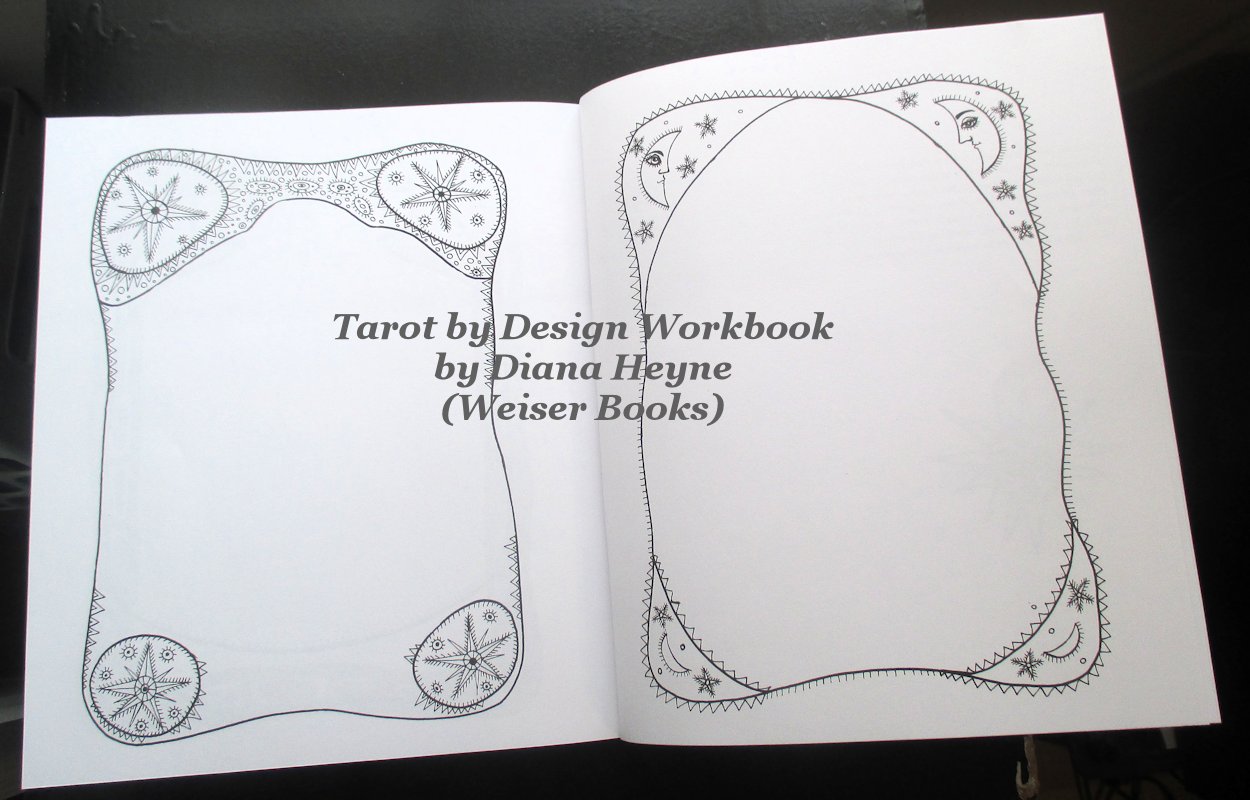
REVIEW: Tarot by Design Workbook by Diana Heyne

R E V I E W

Tarot by Design Workbook
8.5 x 10
176 pages


Adult coloring books are all the rage these days, so it seems like a natural (and great!) idea to publish a coloring book specifically about the Tarot.

Tarot by Design Workbook encourages and allows each person to infuse his or her own intuition, personality, and nature into the study of the cards, while at the same time absorbing or extracting the most personally appropriate, helpful, or meaningful interpretations. It functions as a coloring book, a journal, a textbook, and an inspiration.

The only possible drawback I can see is that with perfect binding, the pages do not lie flat. You will need to use one hand or a weight of some kind to keep the book open flat as you color. The cover of the book depicts colored pencils, perhaps the preferred tool to use with this coloring book. Felt pen coloring might “bleed through” to the other side of the pages, which are printed on both sides. Crayons are too blunt and broad to fill in the finer details of the artwork.

Diana Heyne
The author, Diana Heyne, comes from a family steeped in mysticism. She has studied divination and other esoterica since childhood. Her extensive art background includes a piece in the White House collection (an ornament for the annual Christmas tree). You can visit her Etsy shop to see her fairy furniture and dollhouses: www.etsy.com/shop/pandorajane

The Tarot by Design Workbook is a perfect-bound paperback book featuring original color-in images of the 22 major arcana cards, along with the 56 images of the minor arcana. Each card also gets a “Learning Page” containing keywords for upright and reversed cards, with space for Notes. Learning Pages for the major arcana cards also contain a rhyme or phrase related to the card. At the back are blank pages framed creatively for the reader’s own artwork.


Examples of keywords and affirmations:

THE HERMIT
Upright: soul-searching, prudence, seeking wisdom, introspection, alone
Reversed: isolation, loneliness, fear, withdrawal
Phrase/Rhyme: I walk a lonely path. Only my lantern lights the way. I search for understanding. I seek out wisdom night and day.

8 OF WANDS
Upright: speed, action, swift change, swift movement in travel
Reversed: delays, frustration, waiting, disputes

The pages containing these words and phrases can also be colored in, using different colors to underline, circle, or highlight the words that seem most significant to you, personally.


In her introduction to the book, Diana Heyne writes:

“I have long felt that many people hesitate to set foot on the path of Tarot because even the initial steps can appear somewhat daunting. . . When we engage our visual and kinesthetic senses through the movement of applying color to these images, learning, informed by intuition, takes on a friendlier face. . . What you learn here will provide a foundation that can be built upon to deepen and expand your knowledge and reach whatever level you choose.”


Tuesday, September 20, 2016

REVIEW: Tarot Triumphs by Cherry Gilchrist

R E V I E W

Tarot Triumphs:
Using the Marseilles Tarot Trumps for Divination and Inspiration
Weiser Books


TOP LINE (formerly Bottom Line)

In case we had any doubts about the value of Tarot Triumphs, we are given two pages of praise in the front of the book from such Tarot notables as Caitlin Matthews, Robert M. Place, and Thalassa, among others. Their observations are spot on. I completely agree with Place’s assessment that Tarot Triumphs is an excellent choice for beginners wishing to use the Tarot of Marseilles and for experienced readers as well. I fall into both of those categories in a way, being an experienced reader in general but having almost no experience with Marseille-style decks.

Early on, Cherry Gilchrist tells us that the book “is mainly about Tarot divination: that is to say, using the Tarot Trumps as a means to gain access to knowledge that is normally beyond our conscious grasp.” She succeeds in delivering exactly that, page after page, while focusing very specifically on the Marseilles Tarot, in her case, the Grimaud deck (republished by J.-M. Simon France-Cartes in 1969).

Not only did I learn things about the Marseilles deck from this book (which one might expect, since I had never studied them), I also learned new approaches and information about the Tarot and Tarot reading in general.

I particularly liked Gilchrist’s section on the simplified version of the Celtic Cross Tarot layout. She reduced the number of cards from 11 to 7 because it made less of a “leap” for the reader of this book to go from 3 cards to 7 cards, and because she feels the shorter version works better when using only the Tarot Trumps, which is Gilchrist’s preference.

As someone who is intimidated by the 11-card Celtic Cross, I confess I come close to being mind-boggled by the 22-card Fool’s Mirror spread. Gilchrist does a great job of explaining and giving examples of how to use the spread, and I may yet attempt it.

Although I disagree with some of Gilchrist’s views (for example, that Tarot is not suitable for self-analysis or prediction for oneself), I appreciate her sharing those views and challenging my perceptions.

To those of us who shy away from prediction with Tarot, she simply says, “If you are drawn to Tarot, or indeed any form of divination practice, you already accept the idea of looking ahead.” Good point.

Her advice to readers is sound (for example, “Try not to worry about the reading later, and wonder whether you said ‘the right thing.’”)

I do think that an Index would have been a great idea for this book, making it even more useful as a reference book. Also, I had the feeling while going through the book that quite a few things were repeated, but I realize that repetition is a useful tool that can help people retain a message.

THE PUBLISHER'S PRODUCT SUMMARY

Focusing on the major arcana, or trumps, of the Marseilles Tarot, the aim of this book is to encourage the reader to experience the tarot in a direct, fresh, and uncluttered way.

This exploration of the major arcana includes “The Fool’s Mirror,” a new method for laying the cards out, as well as hints for using the tarot to gain deeper levels of awareness. Cherry Gilchrist offers ways to approach each card, absorb it, and understand its essence. Readers are encouraged to relate this essence to personal experience as the most enduring and rewarding way to prepare for reading the cards.

THE AUTHOR

Cherry Gilchrist wanted to be a writer from the age of four. While still at school, her work was published in a variety of places, ranging from teen magazines to the prestigious 'Poetry Review'. After graduating from the University of Cambridge, diversity continued: she worked in publishing and at running a vintage clothes shop, while practising as an astrologer and bringing up two small children. She then settled down to authorship in the field of creative non-fiction, and has published steadily ever since. Her themes cover alchemy, inner traditions, family history, mythology, life stories, social history and Russian culture. Over the years, she has also become established as a lecturer and tutor, and currently teaches creative writing for the Universities of Oxford and Exeter. Cherry loves travel, especially countries with rich cultural traditions; she has visited Russia many times, plus Easter Island, Burma and Uzbekistan. Every journey is an excuse for a book: see 'Stories from the Silk Road' and 'The Soul of Russia'. Cherry is married to artist Robert Lee-Wade, and they live in Exeter, Devon UK.

SOME OF MY FAVORITE QUOTES FROM THE BOOK
“A Tarot master is, I suggest, someone who acts either as your first true point of contact with Tarot or as a teacher of Tarot at any given moment along the way. Maybe the person is an expert, maybe not.”
“… divination is not necessarily the perception of a fixed future. The diviner should give the person somewhere further to go; the aim is that by seeing the situation more clearly, choices also become more apparent…”
“Divination is linked to time. We ask a question at a particular moment in time, and the answer that comes emerges from that moment.” 
“The way we perceive the Tarot is…a mix of personal response and an understanding of its cultural and mythical content. So overall, Tarot reading offers a chance to practice a balance of intuition and learned information.”
“A woolly approach to divination is likely to produce a vague answer.”

BASIC INFORMATION / APPEARANCE, SIZE, QUALITY / ART

This 295-page quality paperback book features a sturdy multi-color cover designed by Jim Warner, with interior black-and-white illustrations by Robert Lee-Wade. The text is easy to read and separated frequently by heads and subheads to further ease in reading and digesting the information (kudos to Maureen Forys of Happenstance Type-O-Rama for the interior layout). The book measures 9 by 6 inches and is 1 inch thick.

Contents:

  • Introduction
  • Enter the Triumphs
  • The Tarot as a Method of Divination
  • Taking On the Tarot
  • The Wandering Fortune-Teller
  • Becoming the Diviner – Grasping the Fool’s Mirror
  • A Search for Order and Meaning in the Fool’s Mirror
  • The Fool’s Mirror Layout
  • Managing the Reading
  • The Fool Leads Us Further
  • Acknowledgments
  • Notes
  • Glossary


DETAILS / COMMENTS

Cherry Gilchrist begins Tarot Triumphs by asking us to imagine “The Pageant of the Trumps,” a triumphal procession like those that were popular in 15th century Italy, around the time that many believe the Tarot was born. Gilchrist also notes: “There’s no attempt on my part to say that the Tarot set as we know it is derived from a ‘lost’ triumphal procession. . . but. . . it may be a link to how Tarot itself was first conceived.”

Gilchrist uses the terms “Triumphs” and “Trumps” interchangeably throughout the book when referring to the 22 cards of the Tarot Major Arcana, noting that the words are linked linguistically: “the Italian word trionfi translates into “triumphs” and “trumps” in English.” Although the terms have acquired different meanings over time, Gilchrist combines them, also pointing out that “triumph” is something that Tarot is and does. . . “It triumphs through its powerful images, its persistent survival through the centuries, and its capacity to instruct and illuminate those who study it.”

The nine chapters in this book provide a comprehensive account that takes us from studying the history of and symbolism in the individual Major Arcana cards (Marseilles-style) to reading the cards in small layouts, to larger layouts, with references to “Preparing for Your First Reading,” “Whom to Read For,” working space, rituals, and “Ending the Reading.” Gilchrist also addresses the idea of whether we tap into our own unconscious when we read intuitively, or whether we are actually tapping into a greater form of consciousness – a “basin of mind” or “common mind” or “the mind of mankind.”

The chapters that focus on The Fool’s Mirror contain a wealth of information that is helpful to readers no matter what type of reading or layout they choose. Gilchrist learned about The Fool’s Mirror from one of her Tarot teachers. She tells us: “The Fool’s Mirror is a symbol of divination, a means of capturing the impressions that we hope to interpret.”

The book also includes information on Gilchrist’s personal history with divination in general and the Tarot specifically, her first two decks being the Marseilles and The Rider-Waite-Smith. She shares with us her views on commonly discussed Tarot issues such as
third-party readings, storing the cards, reversals, reading for oneself, dummy readings, accepting payment for readings, and prediction.

Throughout the book, Gilchrist documents her sources and elaborates on comments using numbers that correspond to a “Notes” section at the back of the book. The Glossary following the Notes is an extremely useful aid to further understanding the history of the cards along with various terms that are frequently used.


In accordance with the FTC Guidelines for blogging and endorsements, I hereby disclose that this product was provided by the publisher for free. Other than the occasional review copy, I receive no monetary or in-kind compensation for my reviews.  The substance of my reviews is not influenced by whether I do or do not receive a review copy.


Tuesday, September 6, 2016

REVIEW: Tarot Mysteries by Jonathan Dee

R E V I E W

Tarot Mysteries: Rediscovering the Real Meanings of the Cards
by Jonathan Dee
Hampton Roads Publishing Company
(Originally published in 2003 by Sterling/Zambezi )


TOP LINE (formerly Bottom Line)

This is one of those books that makes for interesting reading and can also serve as a handy reference, especially for a reader like me who loves to use astrological associations with the cards. A reader who likes to use Qabalah and Tree of Life associations will also appreciate the tables provided in the book.

I think the book is best suited to people who have a basic foundation in Tarot, astrology, and Qabalah – or at least two of the three. Otherwise, the material could be overwhelming.

I especially like the Court Card descriptions, for which Jonathan Dee provides “Subsidiary Symbols” and a “General Interpretation” aimed at understanding a Court Card when it does NOT represent a person. The sections on “Symbolism” for each Major Arcana card contain a wealth of information, much of which I had not read before. The insights Dee provides for Minor Arcana astrological relationships are extremely useful.

Even if you are a Tarot reader who has no wish to use astrology or Qabalah, you still can gain from Dee’s historical information and card descriptions, as well as his thoughts on the positive, negative, upright, and reversed meanings for each card.

Stay tuned for a reading here on Tarot Notes using The Planetary Spread from this book.

THE PUBLISHER'S PRODUCT SUMMARY

This is a practical and accessible guide to one of the most popular divination systems. What makes this book different from the others is that it:

Provides instruction on reading both the Major and Minor Arcana
Explains why the cards are the cards, why each picture forms part of a sequence, and why they occupy a mystical place in our consciousness
Gives a balanced and informative perspective on each of the cards, as well as an overview of the entire deck
Provides a history of the tarot
Connects the tarot to the Qabalah

This wide-ranging primer provides readers with everything they need to know about the tarot and provides fresh insights into the cards.

THE AUTHOR

Born in Wales in 1957, Jonathan Dee became an astrologer, Tarot card reader, and psychic in the 1970s, working all over the UK and also the USA. His was a familiar name on radio, television, and in magazines. He was also known as an historian and folklorist.

Dee partnered with Sasha Fenton to produce an annual Astro-guides series between 1995 and 2002, in addition to coauthoring the Moon Sign Kit and The Star*Date*Oracle. Dee’s other works include illustrated guides to Tarot, Runes, Feng Shui, Color Therapy, Chinese Face Reading, Astrology, historical works on Ancient Egypt, and the history of Prophecies. Jonathan Dee passed away in 2010.

SOME OF MY FAVORITE QUOTES FROM THE BOOK
“The true origins of the Tarot remain a mystery, but it is a mystery with clues, these being found in the images of the cards themselves, and the occult themes that underlie them. Most notably, these are the signs and planets of astrology, and the complexities of the Holy Qabalah.”
“We should remember that the cards, like many other divination tools, will tend to focus on drama and large events that make an emotional impact. This drama may have already happened, be occurring now, or it may still be a way off in the future.”
BASIC INFORMATION / APPEARANCE, SIZE, QUALITY / ART

This book is published in paperback with a wonderful, creative cover showcasing several cards from the Rider-Waite-Smith Tarot arrayed in front of a High Priestess sort of woman with her arms upraised. On either side we see a nautilus shell, which can be seen as a symbol of growth and evolution. The book measures 8-1/2 by 5-1/2 inches and is about an inch thick (323 pages). The paper is a nice weight, cream colored printed with easy-to-read black type in a serif font.

Illustrations are black and white versions of cards from the Rider-Waite-Smith deck.

DETAILS / COMMENTS

Part One – The Mystery of the Tarot Cards – covers five topics:

  1. What Are Tarot Cards? 
  2. The History of the Tarot
  3. The Holy Qabalah
  4. The Major Arcana and the Zodiac
  5. The Four Grail Hallows

In “The History of the Tarot,” Dee dutifully discusses the heavy hitters of Tarot aristocracy such as Antoine Court de Gébelin, Alliette (Etteilla), Alphonse Louis Constant (Eliphas Levi), Samuel Liddell MacGregor Mathers, Arthur Edward Waite and Pamela Coleman Smith, Aleister Crowley and Lady Frieda Harris. Photographs are included of Levi, Waite, Mathers, and Crowley.

Dee then proceeds to give us “The Known Facts” about the true origin of the cards. This section is quite thorough and interesting. I am not a Tarot historian, so I will have to leave it to others to discuss the accuracy of this account.

We also learn about The Game of the Governance of the World (1459) and the game of Trionfi, which ranks the Trumps in five categories: The Earthly World, The Estates of Man, The Virtues, Hell, and Heaven. Gertrude Moakley’s way of presenting the cards, published in 1966, is fascinating, and not something I knew about before reading this book.

Dee’s discussion of the influence of the Holy Qabalah on the Tarot is detailed and thorough. He includes a Tree of Life Summary, along with Eliphas Levi’s Qabalistic Card Attributions and S.L. MacGregor Mathers Qabalistic Card Attributions. These are presented in table format, making them a handy reference for future use.

Part One continues with astrological associations for the Major Arcana cards, as devised by Levi, Mathers, Joseph Maxwell, Brian Innes, and the Golden Dawn (with a table incorporating both Hebrew/Qabalah and Astrology).

Finally, we have a long section detailing parallels between the Tarot suits and the four “Hallows” (sacred and magical objects in the legends of the Quest for the Holy Grail). This material may not be of great interest to everyone, but might be of special interest to anyone who uses The Arthurian Tarot by Caitlin and John Matthews (illustrated by Miranda Gray; Eddison-Sadd Editions).

From here, we move into Part Two: The Minor Arcana of the Tarot. Dee points out that the symbolism we have come to know and love for these cards is thanks to A.E. Waite and, most of all, Pamela Coleman-Smith, who produced the first set of fully illustrated cards. In this section of the book, we learn about the Golden Dawn’s astrological associations for the four suits, expanded to include the individual cards from Ace to King.

Those who wonder how specific associations for example, “Saturn in Leo” for the 5 of Wands) came into being will find Dee’s discussion informative and engaging. Much of the information is consolidated into table form, which again makes a great reference for the Tarot reader who likes to incorporate astrology into card meanings. Dee also offers a table outlining number symbolism in the Minor Arcana.

Next, beginning with the suit of Wands, Dee discusses the nature of each suit in general, followed by information on each card, including Esoteric Title, Key Concepts, Astrological Relationship, Tree of Life Position, Positive Meaning, and Negative Meaning.

Last (but certainly not least!!!) we move into Part Three: The Major Arcana. Dee describes his interpretations of these cards as follows: “The interpretations in this book are as close to the early ideas a possible, but without harking so far back into history as to make their meanings difficult for a modern card reader to interpret or to explain to his Querent.”

For each Major, we are given its Number, Title, Alternative Title, Qabalistic Letter, Tree of Life Pathway, Direction, Astrological Correspondence, Description, Symbolism, Upright Meaning, and Reversed Meaning. (Dee notes that he only uses reversed cards “when one gets turned around by accident.”)

In Part Four – The Art of Reading the Tarot – we have sections on The Significator, Beginning the Reading, and Layout Out the Cards. Basic Tarot Spreads included in the book are The Horoscope Spread, The Planetary Spread, two Tree of Life spreads, and The Pyramid Spread. Dee follows these larger spreads with a few smaller ones: The Past, Present, and Future Spread (6 cards); When You Need a Quick Answer (4 cards); and The Pathways Spread (6 cards).


In accordance with the FTC Guidelines for blogging and endorsements, I hereby disclose that this product was provided by the publisher for free. Other than the occasional review copy, I receive no monetary or in-kind compensation for my reviews.  The substance of my reviews is not influenced by whether I do or do not receive a review copy.