Order a Reading from Me

Order a Reading from Me
Please send relevant information to zannastarr@gmail.com.

Wednesday, October 19, 2011

REVIEW (by Zanna): The Playing Card Oracles

REVIEW

The Playing Card Oracles
A Source Book for Divination
by Ana Cortez
Illustrations and essays by C.J. Freeman
256 pages; 9 x 6.5 x 0.8 inches
Published by U.S. Games Systems, Inc.
ISBN: 1-57281-522-1


[To see a practice/trial run reading I did with the Playing Card Oracles deck, click HERE.]

Before I continue with my review of this marvelous book, I want to make something clear: The book is not about learning how to read ordinary playing cards. [PLEASE NOTE: I am editing this part of the review to avoid confusion. You can definitely use this book to help you interpret ordinary playing cards. However, it is not *purely* for that purpose. The images in the book are not ordinary playing cards, and the text does go into the symbolism and meaning of those images on each card. I just want people to understand up front that this book is not *strictly* about reading ordinary playing cards.]

The purpose of this book is to explain, explore, and elaborate on a system designed to be used with a deck of cards called The Picture Book of Ana Cortez. At this writing, the cards published by U.S. Games are not readily available.* I found a deck through Amazon.com. I plan to share a reading and/or deck interview in the future on this blog. You can purchase the original deck (produced by Two Sisters Press) directly from Ana Cortez. Contact her at ana@anacortez.org. You can also visit her blog at www.anacortez.com.

You can also use the system described in this book with ordinary playing cards. Ana Cortez tells us to "find a deck of playing cards that you like and follow along." You can even use some aspects of this system with Tarot cards. For example, the notes on numerology and the elements can be applied to Tarot cards. I am planning to experiment with using geomancy (as described in this book) with Tarot cards as well.

FROM THE PUBLISHER'S PRODUCT SUMMARY:
"Every now and then a book comes along that is so strikingly original that it can completely change popular perceptions on a given subject. This is one of those books. In this work of poetry and prophecy, a new voice emerges from a rare father-daughter team."

BASIC INFORMATION

The book is divided into three major sections. BOOK ONE contains four parts: Card Symbolism; Preparing for and Doing a Reading; and Something Old, Something New; and Final Frontiers.  BOOK TWO consists of Essays, Notes, and Commentary written by C.J. Freeman. As Ana Cortez explains in her Introduction, the book is a collaboration between her father (C.J. Freeman) and herself. Cortez first saw her father's larger-than-life oil paintings of the cards when she was about 13 or 14 years old. Over the years she came to see what a valuable tool her father's system could be. In the book Cortez includes material on calendar systems, the four elements, alchemy, astrology, and geomancy. The amount of information may seem overwhelming, but the book offers excellent advice: "Take it in pieces, and practice, practice, practice."

APPEARANCE, SIZE, QUALITY

This paperback book measures 9 x 6.5 x 0.8 inches, thus fitting comfortably in the hands. The black and red ink used for the text stand out nicely on the cream-colored stock. For the most part, the type size and style are easy on the eye. I found the scroll-y font used for the titles of the cards to be beautiful but almost unreadable. However, that did not interfere with knowing which card was being discussed.  The paper is good quality and the binding seems sturdy. The book is very well organized and well written. As a professional copy editor, I usually spot numerous typos and other types of errors in the books I read. I saw none in this book. Win!

ART

As might be expected, the illustrations used in the book are from The Picture Book of Ana Cortez, created by Cortez's father, C.J. Freeman. I found the artwork on these cards to be so compelling that I had to purchase the deck. The artwork is highly symbolic and explained clearly in the book. The illustrations in the book are black, white, and red. In contrast, the back cover features images of the cards in full color. I assume that is what I will be receiving. However, I like Cortez's explanation of the red, black, and white color scheme: "To the alchemists, the trinity of black, red, and white was the magical color combination that corresponded to the three essential phases of spiritual evolution."

BOTTOM LINE

I am fascinated by the material included in this book, particularly the information about divinatory geomancy. As I mentioned above, the book is very well written and a pleasure to read. The various spreads presented in the book -- for example, The Cat Spread and The Lost Man Spread -- are intriguing. You don't have to know anything about other divinatory systems, like the Tarot, but I enjoyed comparing and contrasting the descriptions of these cards with my knowledge of Tarot cards. I am really excited about this system and using The Picture Book of Ana Cortez cards, once I receive my order.

Review edited 21OCT11 and 26 OCT11 by Zanna Starr.

* My source at U.S. Games tells me that the company will be reissuing The Picture Book of Ana Cortez cards in a smaller size but printed on better stock.
----------------------------
In accordance with the FTC Guidelines for blogging and endorsements, I hereby disclose that this book was provided by the publisher for free. Other than the occasional review copy, I receive no monetary or in-kind compensation for my reviews.  The substance of my reviews is not influenced by whether I do or do not receive a review copy.

-->

Sunday, October 16, 2011

Tarot & Astrology by Corrine Kenner - Book Review

(NOTE: This review was originally posted by Helen Howell)

Tarot & Astrology by Corrine Kenner.
Illustrated with the Wizards Tarot by Corrine Kenner & John Blumen
Published by Llewellyn


In a previous post I had said that I was privileged to see an advance draft of the manuscript for this book, so I was looking forward to receiving the published book and was excited when it finally arrived on my doorstep.  The book itself is a nice size, not too big or too small, easy enough to handle. The front cover design is just a delight to look at and the paper quality throughout is good.

In the introduction, Corrine tells us that it will enable one to learn astrology, or tarot or both—depending on whether you are already competent in either one or not. She also tells us that Tarot and Astrology will ‘give you the tools you need to combine the science of astrology with the art of tarot.’  Now to someone like me who is astrologically challenged, I was eager to see if this book lives up to its promise.

Before I tell you any more about this book and what I personally think of it,  I thought I would ask the Book three interview questions and see what it actually had to say about itself. Now you might say how can a book answer questions? But believe me I have found books are just as clever at answering questions as a tarot deck is!

With my first question in mind, Tell me what you consider to be your most important quality? I held the book gently in my hand and let it fall open—it opened at page 225-Houses of the Horoscope and the line that caught my eye was; ‘The planets, signs and houses all come together in a horoscope chart.’

My most important quality as a book is to bring together all the various elements and combine them, so that they form a working platform from which you can glean the information you need.  My strongest quality is to show you, not just how this can be done, but that you can do it.

Now I really like that answer.  You’re a very confident book.

Question two; What is the best way I can work with you? Closing my eyes I flicked the pages until I stopped at page 176. I ended up on the Three of Pentacles page!

The best way you can work with me is to take in the bigger picture, and formulate a working plan. One that you can adhere to, one that allows you to take each step with me, so that we build a partnership together. A partnership that will help you achieve your goal.

That’s very good advice Book!

And the final question; What is the potential outcome of us having worked together?  I ended up on page 95 - The Top Piece caught my eye - The Zodiac Wheel -  Understanding the Wheel of the Year is the key to understanding the astrological associations of the Minor Arcana.

The potential outcome of us having worked with each other, is that you will have gained an understanding of all the elements needed to bring everything together in a working order. One that will allow you to use the information to enhance either tarot or astrology in your use of it.

Well, thank you Book now lets see what I’ve got to say about you. 

 
In the Introduction Corrine goes on to talk about the History of Tarot & Astrology. This was presented in a way that didn’t overwhelm the reader with information but gave just enough to paint a rounded picture. I particularly liked the simplicity of the section ‘The Dawn of Modern Tarot & Astrology. 


In the final part of her Introduction ‘Tarot and Astrology in Action,’  she informs us that she will show us how to combine tarot and astrology by starting with the basics and work up to a complete reading utilising both these modalities. She says that this book will cover all aspects of astrology, along with how to relate them to tarot cards, but she also includes practical spreads and techniques.

In the section ‘Overview,’ we have a breakdown of what to expect to learn and gives us as a starting point the correspondence between the Major Arcana and astrology. This is set out in such a way as to be simple to understand and relate the specific cards to their planetary attribution. At the end of this section she gives us an example of astrology in action using her own deck the Wizards Tarot to illustrate this.

Part 1: Tarot Planets and Signs.
This examines the correspondence between the Major Arcana cards, the planets and the zodiac signs. But first it starts with:-

The Building Blocks of the Tarot - Corrine gives us a basic background of the Major and Minor Arcana and also the sphere of influence for the four suits, along with their elemental attributions of fire, earth, water and air. She tells us that we often describe people using these elemental descriptions such as ‘fiery person’ etc. and she says that these associations are essential to an understanding of astrology.

Included in this section is also an introduction to the Court Cards. She finally touches on number associations for the cards such as Ace being a number 1 and representing beginnings etc. and how that relates to the individual suit. For example: Cups being emotions etc.  For anyone unfamiliar with tarot this section gives a good basic springboard from where to start.

The next part of this section included a list of the planets. When I read it I went  ah ha, I see how that relates, and once put together with the individual cards it made understanding the planets that much easier.

I liked how scattered throughout the book,  we have Cosmic Connections, offering us snippets of information and background to enable us to gain just a little more insight in the subject of how tarot and astrology as a pair have evolved.

Also included in this section was a breakdown of the zodiac signs and their modes along with either their feminine or masculine characteristics.  Following this is a rather nice  Phases of the Moon Spread, which shows one how to set goals and see them through using the phases of the Moon.  - Now I tried this spread out for myself using the Wonderland Tarot Deck. It worked very well and did show me how to achieve that goal.

The section is finished off with a nice touch of providing a summary of the Major Arcana correspondences, so that the reader can see at a glance the astrological attribution given to each card - very useful when one is learning something new!

Part Two - The Minor Arcana
Corrine explains that the Major Arcana elemental correspondences are based on the zodiac signs and that the Minor Arcana are based on the nature of the four elements. For example: Wands relate to the fire signs of Aries, Leo and Sagittarius. We are given the primary and secondary characteristics of the elementary dignities and how that determines how well they mix and match - an example Water is cold and wet as opposed to Fire which is hot and dry.

Next we’re introduced to the Aces and their correspondences. We learn that they go with the four elements and the four seasons. Following this is an introduction to Tarot, Astrology and Qabalah. I liked the detail in this section that gave me a basic insight into the belief and thought system of this philosophy.

So far we are traveling step by step in this book, which is good news for the beginner. I like that it is written in such a way that is not overly technical and therefore easy to grasp.

After that comes the numbered cards and we find that these relate to the 10 degree subdivisions of each sign (the decans). The first Cosmic Connection is showing a chart of the decans and the numbered cards and how they are distributed by element, number and mode. In this part it covers the Zodiac Wheel, Dealing the Cards, Elemental Associations and Planetary Rulers and Sub-rulers signs.

I like the way the elemental associations have been shown along with the modes and seasons, which simplifies the learning process of cardinal, fixed and mutable. Then another chart is presented that allows one at a glance to see the Minor Arcana Assignments.

I enjoyed the tour of the Minor Arcana—the decans were nicely explained by highlighting the sign, mode/quality, element, duality and corresponding Majors. I also think the wheel with each card illustration was a nice touch.

The Court Cards we are told are stationed around the wheel of the year—it appears that it’s their interaction that keeps it spinning. Court Cards in tarot can often be the most difficult to understand, but Corrine has made this easier by their breakdown into their elements and corresponding sun signs. This gives us insight into their characteristics by understanding which sign and element they are attributed.

For example it helps to know that the Queen of Wands is a Fire sign tempered with Water. Also that she represents the zodiac sign Aries, which tends to be more masculine—this helps explain her leadership skills for us. Understanding this connection helps to understand how and why the Queen has the characteristics she has.

The charts at the end of this segment supply a quick reference as to how the various elements describe the characteristics of these Royals. Also how the Wheel of the Year and the Minor Arcana works. A useful and practical aid to learning these correspondences.

Part Three - The Houses of the Horoscope
In this section we learn all about the Houses and that the wheel is divided into 12 pie like sections, one for each sign of the zodiac—easy to grasp? Yes it is!  We learn that the sun, moon and planets move through the houses as the earth cycles through space—the 12 houses then anchor the planets and signs in time and space—even I can remember that!

Again we have a chart that gives you in a glance an overview of the 12 houses along with their ruling planets and signs. There is a spread to try out called The Houses of the Horoscope Spread. Corrine then gives us another visual called Houses of Cards, where we can get to see the signs and planets in their houses and also place their tarot-card counterparts in position. Finally each house is explored focusing on their area of activity. To help us grasp this concept she shows us how to view them from the perspective of their tarot-card counterparts.  Example the first house is ruled by Aries, which is related to The Emperor, but Aries in turn is ruled by Mars, which then relates to the Tower  - this adds that Tower energy to this first house—now we have a feel for this house.

We are walked through polar opposites and shown how to look at them in pairs, again all very easy to understand and make sense of.  There is a brief section on a simplified guide to chart interpretation. Sample readings are provided also of famous people like Prince William and Marilyn Monroe just to name a couple.

What I have liked all the way through this book, is that Corrine has made learning what has always seemed to me at least, a difficult subject, very easy. This book is a springboard to get the student started in either tarot or astrology or both so that they can go on to learn more.

All in all I think that this book keeps it’s promise it made in its introduction, and offers the student the chance not only to learn either astrology or tarot or both in an easy to understand way. But it also shows you how both modalities compliment each other and can take tarot reading to another dimension.

If you have ever wanted to learn either of these skills or both,  then I would recommend this book as a starting point.

------------------------------------------
In accordance with the FTC Guidelines for blogging and endorsements, I hereby disclose that the item being reviewed was provided by the publisher for free. Other than the occasional review copy, I receive no monetary or in-kind compensation for my reviews.  The substance of my reviews is not influenced by whether I do or do not receive a review copy.

Friday, October 14, 2011

REVIEW (by Zanna): Tea Leaf Fortune Cards

REVIEW


Tea Leaf Fortune Cards
by Rae Hepburn
Illustrated by Shawna Alexander
200 cards; 98-page guidebook
Published by U.S. Games Systems, Inc.
ISBN-13: 978-1-57281-670-1
ISBN-10: 1-57281-670-8


As a proud owner of the "original" Tea Leaf Fortune Cards (Journey Editions / 2000), I eagerly awaited the U.S. Games version of this attractive and clever deck. A few things have changed in the new version. For example, the accompanying book is a different size and has a different cover from the old. A quick look through the new book reveals a number of revisions to the text. Another difference is that the U.S. Games version includes photos and descriptions of actual tea leaf readings that were left out of the older version.

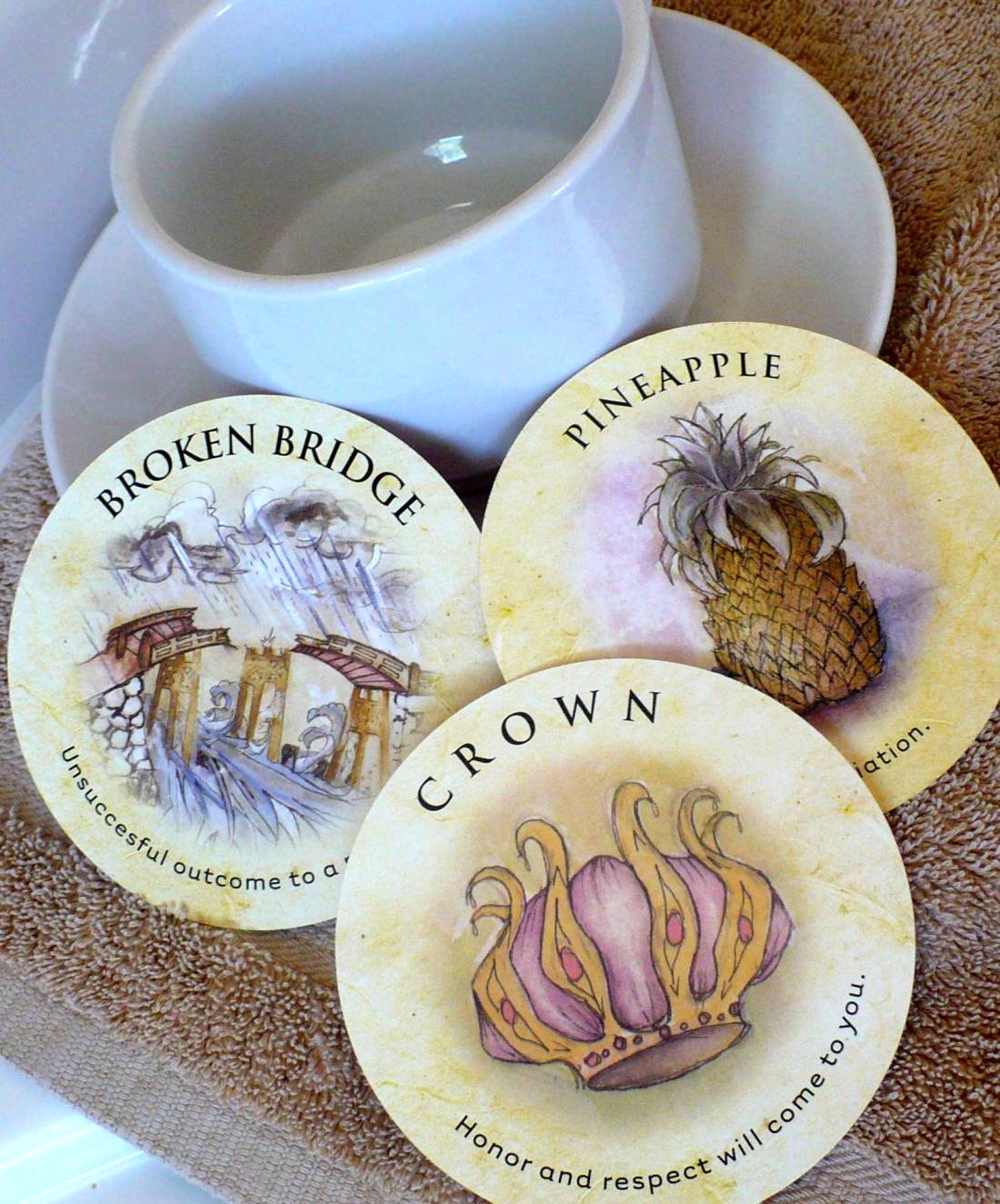
For me, much of the appeal of this deck comes from the round shape of the cards (round, like a teacup!) For my original set, I found a charming box that is absolutely perfect for them.

FROM THE PUBLISHER'S PRODUCT SUMMARY
"Tea Leaf Fortune Cards set offers an innovative system for reading with 200 beautifully illustrated cards depicting the traditional tea leaf symbols. The 98-page guidebook explains how to divine fortunes using tea leaves or Tea Leaf Fortune Cards.
Rae Hepburn, an accomplished tea leaf reader, teaches you to unlock the ancient secrets of reading tea leaves. Follow a few simple guidelines, and you can immediately read your fortune."


BASIC INFORMATION
The set comes in a sturdy cardboard box with a lid that lifts but doesn't come completely off. The 3-1/4 inch round cards are stacked within the larger box in two deep, square trays. The set consists of 200 cards; a 98-page, 5 x 7 inch guidebook; and an 11 x 9-1/2 inch organza bag.


APPEARANCE, SIZE, QUALITY OF CARD STOCK
The card stock is relatively thin but sturdy enough. The pattern on the back of each card features spirals and tea leaves in purple, red, or green, depending on the purpose of the card. There are 12 Months-of-the-Year cards (purple backs) and 6 Astral-House cards (green backs). The red-backed cards feature a title at the top and a key word or phrase at the bottom, for example, "FOREST" and "Muddled, unclear thinking" or "FLUTE" and "Disappointment in a friend or lover."


ACCOMPANYING BOOK
The accompanying book is a true treasure trove of information and sample readings. Hepburn leads with A Brief History of Tea and Tea Leaf Reading, followed by The Development of Tea Leaf Fortune Cards, Traditional Tea Leaf Reading Methods, Divining Your Fortune Using Tea Leaf Fortune Cards (The Coming Year Method, The Coming Week Method, The Astral House Pyramid Method), and Tea Leaf Symbols and Their Meanings. The final chapter is About the Author and Artist.

The Sample Readings are detailed and informative, giving a clear picture of how the reader can relate various cards to each other to gain insight. The section containing the Tea Leaf Symbols and Their Meanings contains a paragraph about each card that expands on the key word or phrase.


ART
Shawna Alexander's realistic artwork depicts objects and experiences from everyday life. The images are small but nicely detailed. The style reminds me of children's picture book illustrations. The coloring is soft, yet rich. I am able to relate easily to the scenes on the cards.

In the near future, Tarot Notes plans to post an interview with Shawna concerning her artwork for this deck.


BOTTOM LINE
I have enjoyed using the Tea Leaf Fortune Cards I purchased ten years ago. The readings I did with the old deck were invariably insightful and thought-provoking, and always called attention to important aspects of the Seeker's outlook and life. U.S. Games has not only recreated the best aspects of this set but has provided extra value with its revisions and additions to the material in the book. I loved reading all about traditional tea leaf reading methods, and I think the images of actual tea leaves in the bottom of a cup are fascinating.

To read a Tarot Notes interview with Rae Hepburn, click HERE.
To read a Tarot Notes interview with Shawna Alexander, click HERE.


------------------------
In accordance with the FTC Guidelines for blogging and endorsements, I hereby disclose that this deck and book set was provided by the publisher for free. Other than the occasional review copy, I receive no monetary or in-kind compensation for my reviews.  The substance of my reviews is not influenced by whether I do or do not receive a review copy.

Monday, October 10, 2011

Journey through My Decks: Queen of Cups (by Zanna)

In this series of posts, I plan to discuss all of the Tarot cards in order, using a different deck for each card. Today I'm exploring the QUEEN OF CUPS from the Rider-Waite-Smith deck*.


Who is this lady seated at the edge of the sea? Water nymphs decorate her throne. Small rocks, polished smooth by the relentless waves, lie at her feet. She is dressed in the colors of the sea -- light blue like the water and white like the foam that rides the crest of the waves. In contrast, a red shell fastens her cloak, which seems also to have red lining. In her hands she holds an object that appears to have her full attention. It resembles a ciborium (a covered receptacle for holding the consecrated wafers of the Eucharist in Christian churches). Winged angels decorate the handles of this impressive container, which can be seen as a representation of the Holy Grail.

In The Tarot: A Key to the Wisdom of the Ages (Macoy Publishing Company), Paul Foster Case tells us that the Tarot Queens symbolize Soul, the inner "pattern" part of a particular human personality.

The Queen of Cups gazes intently at the ornate chalice, symbol of her power. The chalice is closed, its contents concealed from the general public. This Queen is similarly contained and introspective. She is unlikely to reveal all of herself and maintains an air of mystery, like Scorpio, the zodiac sign sometimes associated with this card.

In The Pictorial Key to the Tarot (WeiserBooks), Arthur Waite describes the Queen of Cups as "beautiful, fair, dreamy - as one who sees visions in a cup." He adds, "She sees, but she also acts, and her activity feeds her dream."

Divinatory Meanings (from The PKT): "Good, fair woman; honest, devoted woman, who will do service to the Querent; loving intelligence, and hence the gift of vision; success, happiness, pleasure; also wisdom, virtue; a perfect spouse and a good mother." Reversed: "The accounts vary; good woman; otherwise, distinguished woman but one not to be trusted; perverse woman; vice, dishonour, depravity."

In his book Thinking Tarot (Simon & Schuster), Edward A. Aviza sums up the disparities between the upright and reversed meanings: "She is both the good mother, lover, wife, and so on, as well as the unfaithful woman who falls into a relationship because she is overwhelmed by feeling and passion."

Intuitive, nurturing, and receptive, the Queen of Cups calls our attention to both the positive and negative possibilities inherent in emotional involvement.


* The Rider Tarot Deck, also known as the Waite, Rider Waite, and Rider-Waite-Smith (RWS) deck, designed by Pamela Colman Smith under the direction of Arthur Edward Waite. Copyright 8 1971 US Games Systems, Inc. ISBN 0 913866 13 X.